

Va'aifetū – about the practice model
Va'aifetū is our practice model for working with Pacific children, young people and families across all areas of practice – youth justice, care and protection, adoptions and caregiver recruitment and support. It is for Pacific and non-Pacific kaimahi.What is Va’aifetū
Va’aifetū draws on the traditional and ancestral knowledge of the island nation cultures it represents to support culturally responsive practice.
However, culturally responsive practice is not only culturally informed but also consistent in application and clear in rationale for achieving change and restoration. As our practice model for working with Pacific children, young people and families, Va’aifetū bridges cultural knowledge and applied practice, enabling the cultural knowledge to inform and strengthen our practice while not overriding social work practice and other professional disciplines.
Va’aifetū helps us to understand, from a perspective of the unique circumstances of a Pacific child or young person and their family:
- what is happening
- what needs to happen
- how this should happen, to make those circumstances better.
Located in whai oranga, Va’aifetū guides us in the pursuit and restoration of wellbeing-focused safety for Pacific children, young people and families in ways that are culturally responsive to them.
When we use Va’aifetū
Practice policy requires us to use Va’aifetū whenever we work with Pacific children or young people and their families.
We use Va’aifetū alongside:
- other models (including Te Toka Tūmoana and the tangata whenua and bicultural supervision model)
- existing practice tools and resources.
We evidence the application of Va’aifetū in case records and written assessments.
Importance of culturally responsive practice
Culturally responsive practice is critical to working effectively with Pacific children or young people and their families.
Va’aifetū supports us to recognise and understand culturally specific wellbeing concepts and the protective factors inherent in indigenous Pacific knowledge.
There are fundamental differences between Pacific peoples that need to be acknowledged and understood for us to be effectively responsive to their wellbeing needs, safety and protection.
Pacific cultural diversity is shaped by distinct worldviews, values, practices, history and lived experiences. Understanding Pacific cultural differences helps us appreciate diverse concepts of wellbeing and how cultural values and practices protect and restore wellbeing and safety. This is aligned to our mana-enhancing paradigm for practice, which values indigenous knowledge, the significance of history, and narratives as cultural identity, and requires us to work from a principled position.
Diversity of Pacific cultures
Nine island nation cultures are represented in Va’aifetū:
- Cook Islands
- Fiji (iTaukei and Fiji Indian separately)
- Kiribati
- Niue
- Samoa
- Tokelau
- Tonga
- Tuvalu
While not an exhaustive representation of island nation cultures of the Pacific, these are the largest Pacific ethnic groups in Aotearoa New Zealand, and an acknowledgment of the diversity of Pacific cultures.
Each island nation culture is represented by its own cultural approach and set of practice prompts:
Va’aifetū principles
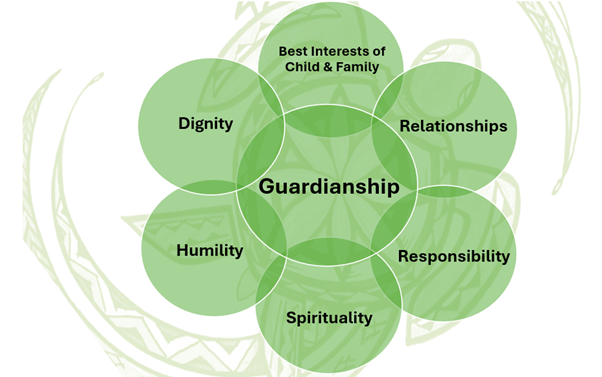
Va’aifetū incudes overarching principles that connect the spaces of diversity between Pacific cultures.
These are key shared cultural principles that play a vital role in supporting wellbeing, including safety and protection for Pacific people. The principles govern collective expectations of behaviour and shape Pacific people’s sense of identity and belonging. To support our understanding of the principles’ relevance for practice, each is accompanied by a description of its significance for the child (or young person), the family or the practitioner.
An overarching understanding is a good starting point and useful for applying to island cultures outside of those included in Va’aifetū. However, while the Va’aifetū principles are connectors of Pacific cultures, they are expressed differently across Pacific cultures. We need to understand how Pacific cultures are motivated differently according to their own values. For example, one island nation might prioritise the principles differently from another.


Va’aifetū cultural approaches and practice prompts
Cultural approaches and practice prompts in Va’aifetū activate treasures, knowledge and information, beliefs and practices central to their island nations. They demonstrate the application of the Va’aifetū principles in practice through the cultural perspective of each island nation represented in the model.
The combined offer of cultural approaches and practice prompts support us to work in relational ways that are inclusive and restorative. In combination, they show us how we can work with Pacific children or young people and their families to help resolve issues of child abuse, harm, maltreatment and youth offending while being purposefully oriented towards wellbeing and restoration.
Va’aifetū cultural approaches
While not an exhaustive representation of island nation cultures across the Pacific, the structure of Va’aifetū signposts a consistent approach for exploring essential aspects of Pacific cultures to support practice with its children, young people and families. The 9 cultural approaches in Va’aifetū, while offering an integration of culturally specific knowledge and practice, adhere to a consistent structure. This means the application of each cultural approach is the same and if, for example, we are working with a child or young person of mixed Pacific ethnicity we can navigate between more than one relevant cultural approach in a consistent way.
Each cultural approach:
- incorporates the worldview of the island nation culture it represents to support our understanding of values underpinning beliefs, behaviours and practices
- describes the social structure to support our understanding of roles, responsibilities and significant connections in families and communities
- is explicitly oriented towards wellbeing (oranga), incorporating and demonstrating key values that uphold wellbeing and their application to practice.
Each cultural approach has a visual representation providing a metaphor for practice from that specific cultural perspective.
Using the cultural approaches in the model to create or support change
The cultural approaches should be used to create or support change by:
- deepening our holistic understanding of the wellbeing of the Pacific children, young people and family we are working with
- building awareness of wider support networks and the significance of these for practice
- guiding us to engage respectfully and effectively with families, extended families and communities
- understanding the importance of key cultural values, beliefs and practices for working inclusively, relationally and restoratively
- guiding the appropriate steps to effect change leading to safety, restoration and healing.
Application involves being intentional about our ways of relating, understanding, planning, acting and reflecting with Pacific children or young people and their families.
Each cultural approach provides significant features
- Each cultural approach provides significant features that draw on values and practices that underpin the worldviews of the island nation it represents and help support our understanding of what is important for wellbeing from the viewpoint of those children, young people and families. The cultural approaches, with the support of the practice prompts, will guide you to an understanding of wellbeing from a specific island nation worldview. This will add to and build on the interconnected understanding of oranga from a Te Ao Māori perspective.
- The significant features also recognise the ways in which the social structure is central to each island nation, and the values and practices that support, influence, motivate and impact on children or young people and their families. This awareness acknowledges the nature of vā (relationships) within this structure and why these are important, what they look like when they are working well and when they are not, and how this contributes to the current situation for the children or young people and their families. Understanding of these structures guides and enables us to understand how to be relational, inclusive and restorative, working towards improved ways that resonate culturally for them.
- The significant features also highlight key aspects and dimensions of wellbeing for its island nation and the values that support and maintain these. Understanding and adherence to these values and practices ensures that children, young people and families continue to have agency in defining and achieving their wellbeing aspirations and build our cultural competency.
Using the practice prompts to create or support change
The practice prompts invite and encourage us to think more deeply about the Va’aifetū principles as signposts for wellbeing. The prompts connect the principles to each cultural approach, demonstrating the unique expression of each principle in application through the worldview of that island nation.
The Va’aifetū principles are represented by individual practice prompts that:
- give examples to demonstrate what each principle looks like when applied in practice
- demonstrate how cultural values unique to each island nation are relevant in the context of each principle
- offer questions for self-reflection and deeper thinking about practice with Pacific children, young people and families
- connect with the island nation cultural approach where associated cultural values can be explored in more depth.
Cultural profile of Pacific children, young people and families
The cultural profiles of the children, young people and families we are working with must be explored and understood in the application of Va’aifetū and for us to work effectively with them. Their profile will be situated across a cultural continuum from traditional to contemporary.
In cases where households are multi-generational, made up of island born and New Zealand born members, or ethnically mixed (Pacific and non-Pacific), location on this continuum may vary for individuals in the same home and family. This may or may not be a source of tension, or a contributing factor for the issues creating a need for our involvement. However, this is still an important consideration in our application of Va’aifetū.
If you need further support, seek advice from an ethnic-specific cultural advisor.
Can't find what you're looking for? Try the search bar or view policies.