

iTaukei – Fiji cultural approach
iTaukei is an ethnic-specific cultural approach for Va'aifetū that offers all practitioners essential cultural and practice knowledge, skills and behaviours for working with Fiji children, young people, families, caregivers and communities.iTaukei
Solesolevaki sa itakele ni duavata. Solidarity is the cornerstone of unity.
iTaukei is oriented to wellbeing and safety. It offers essential and desirable foundational knowledge for working effectively with indigenous Fiji (iTaukei) gone lalai/taba gone (children/young people) and matavuvale (family), caregivers and communities, across child protection, youth justice, adoptions and all other areas of our practice.
iTaukei provides insights about the cultural context of vakavanua (iTaukei customary ways) and bula vakavanua (iTaukei way of life). These customary patterns of behaviour and practices are central to a holistic understanding of sautu (wellbeing) for gone lalai/taba gone and matavuvale.
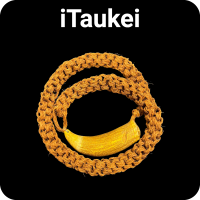 The tabua (whale tooth) has profound significance for iTaukei people, symbolising status and respect and signifying the importance of relationships. A highly valued and sacred object, the tabua is believed to have divine power, embodying the presence of ancestors and providing a connection to ancestors and the spiritual world. The image of the tabua provides a strong metaphor for the sautu (wellbeing) of gone lalai/taba gone (children/young people) and metaphorically the gone lalai/taba gone and matavuvale are represented by the whale tooth, symbolising respect, connection and belonging. Just as the tabua is a precious gift so too are gone lalai/taba gone a precious gift and they represent the future of the iTaukei community.
Worldview
The iTaukei worldview is shaped by key values and beliefs that uphold the interconnectedness and sacredness of relationships as a natural part of life. This worldview regards all life phenomena – physical, metaphysical and spiritual – as a connected manifestation of the whole and focuses on the relationships among its entities for the maintenance of the whole.
Clashes in Western and iTaukei philosophy, by Eta Varani
Characteristics of the iTaukei worldviews are the emphasis on connection to land, collectivism and community and family, culture and tradition, and spirituality. These are embodied in the following principles.
The traditional practice of working collaboratively, rooted in the communal and familial structures of iTaukei. Solesolevaki emphasises the importance of collective responsibility and shared resources and in a cultural context demonstrates the strengths of familial ties.
 Practice consideration – Solesolevaki exemplifies how collaboration and mutual support can enhance wellbeing. In the social work context, drawing on the practice of solesolevaki encourages individuals to contribute their strengths and skills to address not only immediate needs but also build sustainable solutions through long-lasting relationships and networks. In the context of harm to a child or youth offending, the practice of solesolevaki mobilises iTaukei and resources to assist the child, young person and family through a restorative process for making things right, where sautu (wellbeing) is restored and continually maintained for all (Cagivinaka, 2024). The practice of family group conferencing has a natural alignment to solesolevaki.
Family lineage and history – knowing who you are and where you come from – is of paramount significance, providing a framework for identity, belonging and social structure. This understanding is vital for establishing relationships and responsibilities in the community. Kawa also conveys the legacy of ancestral achievement and social standing and thus is accompanied by clear expectations on family members for respecting and upholding the standards of behaviour, responsibility and achievement of their lineage.
 Practice consideration – Acknowledging, exploring and understanding lineage and family history with iTaukei gone lalai/taba gone (children/young people) and matavuvale (family) helps to build rapport and trust while giving an insight into their worldview and values. The historical context of matavuvale provides social workers with an opportunity to better understand the collective and individual strengths and challenges of the matavuvale and its members.
Wellbeing – Sautu
Sautu denotes a state of being that signifies peace, harmony, prosperity and wellness. It is epitomised in the iTaukei greeting ‘bula vinaka’, which literally translates to ‘good life’ or ‘good health’ and conveys a wish for a healthy and prosperous life to the person being addressed. iTaukei aspire to achieve a certain state of harmony, prosperity and stability in life where relationships are mutually reinforcing and respectful. The greeting ‘bula vinaka’ reflects the iTaukei value of positive relationships for wellbeing, embodying a sense of warmth and hospitality in social interactions.
‘Sau’ reflects being filled with mana arising from one’s position or fulfilment of one’s role and ‘tu’ is to rise following the successful discharge of one’s duty. When iTaukei fulfil their birthright roles to the best of their ability, balance and order ensues and sautu can be achieved. Sautu represents positive achievement for iTaukei, likened to the top-most part of a house (doka ni vale), which serves as the crowning glory in the building process. Sautu relates to a family’s ability to sustain itself and deal with life’s challenges.
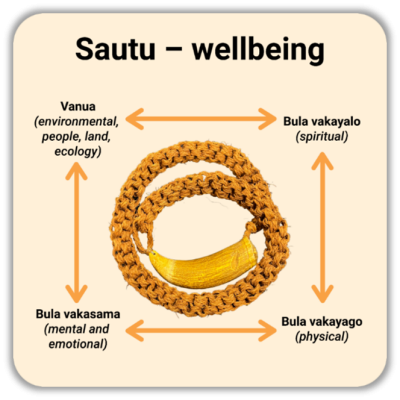 Wellbeing for iTaukei children and families encompasses their social, spiritual, physical and emotional needs and can be understood holistically across four interdependent dimensions: vanua, bula vakayalo, bula vakayago, bula vakasama.
Harm to gone lalai/taba gone (children/young people) is a breach of sautu. Traditionally when such a breach occurs, the turaga (chief) can activate a response through the practice of solesolevaki (when a village collectively works together towards a common goal). The turaga will initiate talanoa (collective discussion) for the mobilisation of support and care from the tutu vakavanua to address the breach or harm. A perpetrator can be banished from the village until sautu is restored for the gone lalai/taba gone and matavuvale (family). Restorative actions through solesolevaki can create the conditions for the perpetrator’s return to the koro (village/community). From a New Zealand perspective, social workers can utilise the solesolevaki within the family group conference process and safety planning.
Practice consideration – Solesolevaki encourages collective responsibility for the wellbeing of gone lalai/taba gone (children/young people) and creates a supportive environment for matavuvale (family) and community members to actively contribute to their safety and protection. In the context of youth offending, the practice of solesolevaki can be integrated into restorative justice practices, including family group conferences. The traditional practice of banishment as a response to a breach of sautu (wellbeing) is a useful cultural reference for safety planning with solesolevaki as the mechanism for working with gone lalai/taba gone and matavuvale to ‘create the conditions for the perpetrator’s return’.
Kaimahi talks about wellbeing
Application of values to practice
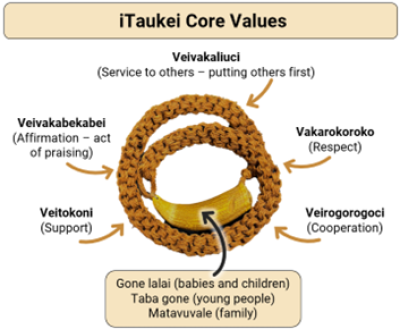 The tabua is used in rituals and ceremonies, and at significant events including weddings, funerals, negotiations and state occasions. It adds reverence to expressions of gratitude, reconciliation and apology. In all circumstances, the tabua is presented with great reverence and received with deep appreciation and is an acknowledgment of the significance of the occasion and respect for the people involved.
As a tangible representation of iTaukei values, which uphold and maintain their spiritual, relational, cultural and emotional needs, the image of the tabua provides a strong metaphor for the sautu (wellbeing) of gone lalai/taba gone (children/young people) and matavuvale (family).
The magi-magi (woven coconut fibres) attached to the tabua are a metaphor for those cultural values vital for the collective wellbeing of gone lalai/taba gone and matavuvale (family) interwoven for strength and holding the tabua at each end to maintain stability and balance.
In terms of social work practice, the tabua can be used as a tool and metaphor to open respectful dialogue between social worker and matavuvale (family), koro (village/community), mataqali (clan) and tokatoka (sub-clan) in an appropriate manner. The significance of the tabua provides a safe space for everyone involved to be included in the talanoa (conversation) – everyone has a voice and feels valued. The tabua can also be used for restorative purposes to bring peace and wellbeing and used as a social contract or agreement between two or more people (refer to Ratu Kasami's 2023 assignment on the tabua metaphor). For example, when conducting a home visit to iTaukei, using the tabua in reference to gone lalai/taba gone (children/young people) serves as a powerful metaphor. By using the tabua as a symbol, the family recognises that their gone lalai/taba gone are of equal importance and respect, just as the tabua is esteemed within their culture. This metaphor highlights the value and reverence placed on gone lalai/taba gone, fostering a sense of dignity and worth.
Practice consideration – The metaphor of the tabua (whale tooth) can be applied to the circumstance of an iTaukei gone lalai/taba gone (child/young person) coming into care. Just as the tabua represents connection to heritage and community, state care represents a disruption of those connections, indicating a need for support and reconnection. As a precious and revered gift, the tabua acknowledges relationships and responsibilities. Similarly, a child or young person coming into care must have their rights and worth recognised and upheld and there is a responsibility on the state to uphold rights, recognise worth and protect the iTaukei child or young person. The values of respect and honour embodied in the tabua extends to the iTaukei child or young person whose dignity must be upheld and cultural identity respected through all aspects of their care experience.
iTaukei practice prompts
 The iTaukei practice prompts:
- cover important principles and values
- explain what our practice should include for each one
- provide a set of reflective questions.
Useful words and phrases
Can't find what you're looking for? Try the search bar or view policies.
Social structure
iTaukei social structure is characterised by hierarchy, collectivism, kinship obligations and responsibilities, and respect for authority. It is deeply rooted in communal values and interconnectedness, which significantly supports the sautu (wellbeing) of iTaukei gone lalai/taba gone (children/young people).
Identity and belonging are intrinsically linked to one's role in the collective, ascribed through birth, defining the nature of relationships between people and identifying levels of hierarchy within families and wider society. The wellbeing of the collective is maintained when members understand and act in accordance with their roles and responsibilities in this structure. To understand the totality of the iTaukei social structure, it is important to understand the wider structural systems that support and maintain cultural identity, rituals and beliefs, and in which order is adhered to in a safe and loving environment.
Indigenous iTaukei Worldview, by Dr Tarisi Vunidilo
iTaukei connect with each other by enquiring about each other’s origins, thereby establishing traditional links and kinship ties. Identification and connectedness occur across the levels of society from confederacies through to tokatoka.
Tutu vakavanua is the traditional social structure of iTaukei that exists within each yasana (province). It is a strongly hierarchical system with an emphasis on communal responsibility and cultural practices. Each role in the structure has discrete responsibilities that contribute to the wellbeing of the community. This communal responsibility is demonstrated in the circular representation of the social structure.
iTaukei are born into tutu vakavanua with ascribed roles and responsibilities. Individuals inherit their roles and responsibilities from both maternal and paternal lineage, which means they can simultaneously be a turaga (chief) on their paternal side and a bati (warrior) on their maternal side. This means they are required to fulfil different roles in various contexts, such as serving as a turaga (chief) for situations relating to their paternal lineage and a bati (warrior) for situations relating to their maternal lineage, but the roles are not served simultaneously within those distinct situations. Tutu vakavanua birth roles are lifelong and represent one's standing or position in the matavuvale (family) and vanua (land).
Indigenous iTaukei Worldview, by Dr Tarisi Vunidilo
As iTaukei communities have become established in Aotearoa New Zealand, traditional social structures and roles have adapted to the different environment while still reflecting the values of traditional iTaukei society. The emphasis on kinship ties, collective support and responsibility, and community leadership has persisted and continues through communal activities and places. Churches, schools, cultural groups and friends all play a vital role in preserving the language, culture and identity of iTaukei. iTaukei participation in these processes demonstrates the strength of cultural ties and connections to wider support system.
Matavuvale refers to an extended family group, which, in addition to immediate family members, encompasses a broader network of relatives, aunts, uncles, cousins, etc. The matavuvale emphasises the collective identity and support among its members with a strong sense of community and belonging. Vuvale refers to the nuclear family of parents and children and in that context the emphasis is the relationships, roles and responsibilities of the members of that family unit. iTaukei values of collectiveness and connectedness underpin the importance of matavuvale and vuvale systems, where responsibility for children and family wellbeing is collectively shared.
While variations on specific family customs and local practices occur (for example, women can also hold the title of turaga (chief)), the matavuvale (family) is predominately patriarchal. Traditional roles are usually defined by gender, with men assuming the responsibility of provider and protector, decision-maker and leader in the family structure while women are the carers, nurturers of the children, and responsible for the day-to-day logistics of maintaining the household.
Traditional roles encourage collaborative parenting where extended family members actively participate in nurturing and teaching children and provide a network of support around the vuvale (nuclear family). Elders, who are revered as custodians of knowledge, tradition and wisdom, play a significant role guiding families and communities and instilling cultural values in children that build their identity and sense of belonging.
Gone lalai/taba gone hold a significant and cherished position in iTaukei society, viewed as the future of the community and the bearers of tradition and culture. Child rearing includes the practice of praising, nurturing and forecasting good health and sautu (wellbeing) for children from the moment of conception. Their upbringing is a communal responsibility, and they are nurtured in a supportive environment, learning from their parents and elders through observation and participation in communal activities to understand their role and responsibilities so they will become responsible adults contributing positively to the community and society.
Gone lalai/taba gone also have a role in the sautu of the family, and they are taught early to contribute to family life by helping with domestic chores and/or caring for younger siblings. This contribution is a tangible expression of the communal ethos of iTaukei culture.