

Mo'ui Fakalata – Tongan cultural approach
Mo'ui Fakalata is an ethnic-specific cultural approach for Va'aifetū that offers all practitioners essential cultural and practice knowledge, skills and behaviours for working with Tonga children, young people, families, caregivers and communities.Mo'ui Fakalata
Fakatapu – clearing the path for Mo‘ui FakalataHolo pe ho‘o mou me‘a, ka mau hao atu hē,
kuo mau ta‘imālie ‘i he ‘ofa ‘a e ‘Otua,
tu‘unga ai ‘emau fakafeta‘i ‘i he ‘etau ‘inasi ‘i he mo‘ui
pea tau femātāki ai he ‘aho ni.Fakatapu ki he kelekele ‘eiki ni,
fakatapu ki he hou‘eiki ‘oku me‘ā,
Te Arikinui Kūini Nga wai hono i te po,
moe tangata whenua ‘o Aotearoa.Fakatulou atu kihe taki ‘o e potungāue,
fakafe‘iloaki atu ki he sola mo e vulangi.Pea talangata ‘iate kimautolu ‘o fai ki tu‘a mama‘o,
kae ‘atā ke fakahoko atu e fakamatala ko ‘eni,
kihe fakakaukau kuo fatu ‘e he kau ngāue Tonga ‘o e potungāue ni,
ke tataki ‘aki ‘emau ngāue moe kāinga Tonga.
 The Mo‘ui Fakalata cultural approach offers Oranga Tamariki practitioners foundational knowledge and skills for working with Tongan fanau (children and young people) and their kāinga (immediate and extended family), caregivers and communities, across child protection, youth justice, adoptions and all other areas of our practice. Mo‘ui Fakalata provides deeper insights of cultural context about anga fakatonga (Tongan customary ways) and mo‘ui fakatonga (Tongan way of life). These patterns of behaviour and practices are central to developing a holistic understanding of fanau and kāinga.
Mo‘ui Fakalata cultural approach is organised to ensure cultural knowledge and contextual relevancy can deepen social work understanding and articulation of practice. The first part of this webpage gifts cultural knowledge that is central to Tongan fanau and kāinga. The second part focuses specifically on the Mo‘ui Fakalata cultural approach, its centrality to wellbeing and safety application to practice within a statutory context.
Koloa – treasures of Tongan fanau
Tongan fanau (children and young people) are seen as koloa (treasures) and a gift from God which is expressed in the Tongan proverb: “koe fanau koe mata‘i koloa”. Fanau come with their koloa (riches that are significant and valuable) that includes cultural heritage such as values, belief systems, customs, relationships, qualities and connection to their local environment. For some, connections to these treasures may be weakened or lost. A social worker must be able to access and utilise these understandings during the social work process to identify key strengths, weaknesses, and concerns.
Worldview
A Tongan worldview are constructs of values, beliefs and behaviours that is central to the tangata kakato (whole person, in this context is fanau). This fundamental understanding enables the social worker to be informed of their cultural context. Tongan worldview centres on 3 notions: sacredness of all things, priority is people, family and community, and relationships.
The Political Wisdom of Our Forefathers, by Siotame Havea
Anga fakatonga/Tongan core values
Traditional practices, culture and values play a significant role in promoting wellbeing and safety for fanau (children and young people). Anga fakatonga (Tongan culture) form the foundation of moral standards, which explain interactions of fanau and kāinga with one another.
Reference: Tongan mother’s contributions to their young children’s education in New Zealand: Lukuluku ‘a e kau fa’e Tonga ki he ako ‘enau fanau iiki ‘i Nu’usila, by LIK MacIntyre (page 21)
Becoming Tongan: an ethnography of childhood, by Helen Morton
From a Tongan perspective, a deeper understanding and execution of these values will assist the social worker do their utmost to make connections, discover needs in their assessment, decision-making and planning with fanau and kāinga. These values are known as the faa‘i kavei koula (4 golden strands of the Tongan culture):
- Faka‘apa‘apa (respect)
- Anga fakatōkilalo (humility)
- Tauhi vā (maintaining and looking after relationships)
- Mamahi‘i me‘a (loyalty)
Tauhi vā: Nurturing Tongan Sociospatial Ties in Maui and Beyond, by Tēvita O Ka'ili (pages 89 to 94)
An important value that binds and connects these together is ‘ofa (love, compassion).
These values are of immense importance when working with Tongans as they inform everyday practices.
Wellbeing
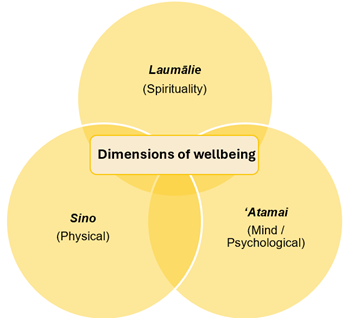 Wellbeing refers to a holistic understanding of the mo‘ui kakato (whole person), which comprises mo‘ui lōtolu (the 3 dimensions essential to wellbeing). For Tongans, wellbeing is associated to the quality of life in its entirety. The mo‘ui lōtolu consists of:
- Sino (physical) – the state of your physical body is responsible for holding together one’s mind and spiritualty. The physical body influences the quality of your mind and spirit. If your body is weak, it is not able to perform certain functions. This will eventually take a toll on your mind and then your spirituality.
- ‘Atamai (mind/psychological) – expressing a positive outlook is key because negative thinking will weaken one’s wellbeing or mind. For example, strengthening and sustaining mental health means looking after the many relationships that are of importance to the individual and the collective. This involves fulfilling fatongia (duty and responsibilities), which gives a sense of purpose for existence, pride and contentment but at times can also be presented with challenges.
- Laumālie (spiritual) – acknowledging our laumālie (spirituality) and the way we see and connect to the spiritual world is important. Spirituality is usually expressed in Christian faith. Engagement and participation in events such as church services, church groups, choir, fellowship groups, Sunday school and youth activities play a big part in wellbeing.
Tongans believe that their lives are complete when these 3 elements are in order, balanced and cared for.
Kaimahi talk about wellbeing
Mo‘ui Fakalata application to practice
This approach acknowledges that culture is ever evolving and that different families may be at various stages of that evolutionary journey or continuum. For example, some families might be very conservative and traditional, and therefore hierarchical top down in their relationship, while some families, influenced more by New Zealand context and other factors, may be less hierarchical and more inclusive and accommodating of the views, voices of young people and children.
Mo‘ui Fakalata
Mo‘ui Fakalata encompasses what it means to be well and safe from a Tongan perspective. Mo‘ui Fakalata comes from 3 words:
- Mo‘ui denotes life and wellbeing. It refers to a multi-relational living that is healthy and well. Mo‘ui also refers to the wellbeing of peoples and communities as important components of the ecology (fonua).
Fonua: A model for Pacific health promotion, by Sione Tu'itahi - Faka is a prefix and lata is a verb that describes a state of being. Lata means ‘pleasant, happy, safe and content’. When the prefix faka is placed in front of lata, it moves this from being a state to the actions that achieve that state of being. Fakalata recognises that fanau who come into the child protection and youth justice space are often in an unpleasant state and are in unsafe situations. Therefore, Mo‘ui Fakalata evokes actions that enables fanau to have enjoyment of life, safety and symbolise one’s specific and collective relationships and responsibilities.
This cultural approach underpins effective social work practice with fanau Tonga, their kāinga and communities, applying a holistic approach to life and peaceful co-existence.
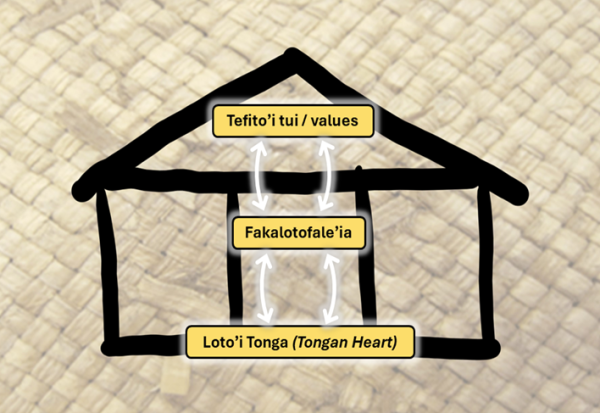
Wellbeing is aligned to a Tongan fale due to the cultural significance in the Tongan society. The fale is not just a physical structure but a symbol of community, family and interconnectedness. It reflects the idea of being in harmony with the environment and promotes safety and wellbeing. The fale is a gathering place for families and communities. It serves as a safe space for sharing, socialising, discussing important matters and offering support to one another. This sense of connectedness and support is essential for overall wellbeing. The fale also embodies the traditional values and customs of Tongan culture.
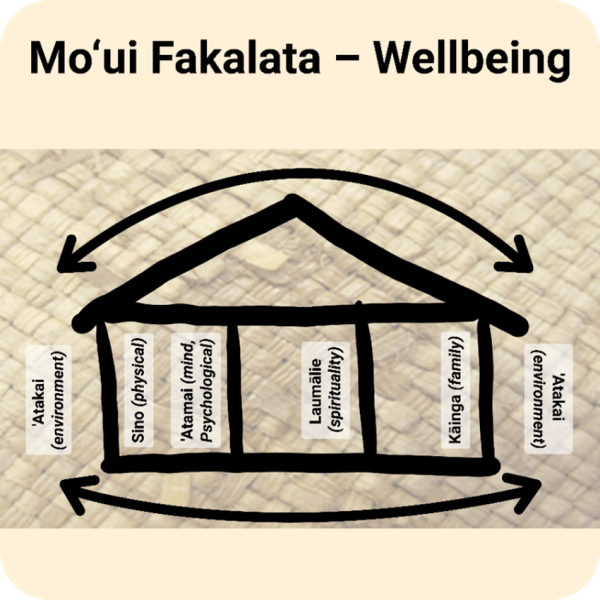
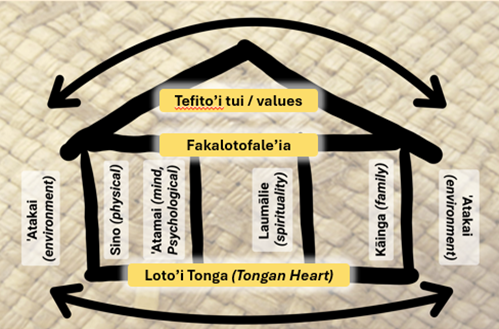
There are two added dimensions of wellbeing for Mo‘ui Fakalata which extends to the three (as shown in the diagram). The two additional dimensions are:
- ‘kāinga’, which refers to the immediate and extended family
- the influence or impact of ‘Ātakai (environment).
Understanding these dimensions is a critical part of building and monitoring ongoing safety, including in the context of offending, for fanau.
Kāinga is fundamental in Mo‘ui Fakalata as it reflects the collective, reciprocal and supportive role each individual member contributes to achieving holistic wellbeing. ‘Ātakai (environment) is crucial and significant to the overall wellbeing of fanau. Connections and accessibility to resources are vital for the livelihood of the fanau and kāinga. Considerations need to be given to the fonua part of the environment (cultural heritage of what it means to be Tongan in Aotearoa New Zealand). But one must be mindful in the environment that has been constructed by mankind which influences wellbeing.
Together these dimensions (physical, mind, spirituality, family and community, and environment) radiate harmony within each other. This harmony is referred to as ‘napangapanga mālie’ (that all the dimensions are well and balanced). The absence or compromise of any one of these disrupts harmony and can result in a home without peace, safety, joy or laughter.
The spirit of Mo‘ui Fakalata is aspirational and focuses on the potential strengths of the fanau and kāinga. One of the core beliefs of Mo‘ui Fakalata is in the innate power of human spirit to overcome obstacles and difficulties. As mentioned, the dimensions can be seen as both a protective and risk factor that may strengthen and/or weaken the fanau and kāinga wellbeing. Safety factors offer understanding to build safety for the fanau by identifying a network of relationships and factors to consider.
The following tools can be used by social workers in their social work engagement and process.
Fala (Tongan mat) – a relational metaphor
Tongan fala (mats) are one of the most treasured possessions in Tongan households and hold significant importance to the wellbeing of Tongan people. The mat symbolises that working with Tongans should be relational and inclusive of ‘api (those within the home) and kāinga (extended family and community).
Papata pē ka na‘e lalanga is a well-known metaphor which means that we might put a lot of effort into making something and while the outcome may not always be perfect, it is still purposeful (MacIntyre, 2008 – pages 10 to 11). Mo‘ui Fakalata acknowledges that children, young people and their families come with their own mat that had already been woven. Sometimes the strands of those mats are broken, impacted by being oppressed and marginalised by relationships. These often lead to unsafe and harmful decisions. The fala offers a way to deepen cultural understanding to restore, protect and strengthen the broken strands enhancing wellbeing.
Fakalotofale‘ia
Fakalotofale‘ia is the process where sensitivity of all things is respected and observed. It is a Tongan interrelational system that is used to engage, seek and receive information. The process of fakalotofale'ia occurs within the fale and its attendant values and expected ethical standards and etiquette are carried out. Its intent is to sustain harmony within relationship, facilitate safety for all parties to talanoa and ensure accountability. Fakalotofale'ia is also a process of kāinga decision-making to achieve best interests and safety for fanau. It is evoked in times of crisis because of its restorative and preventative elements.
Fakalotofale'ia: a sanctuary of wisdom in the supervision relationship, by Aulola Lino
Reference: Introducing disability concepts with integrity into Tongan cultural context, by SLT Tahaafe
The essence of the Tongan heart
To meaningfully engage Tongans, it involves the loto (or heart). The concept loto is central to understanding a Tongan way of life and being. The tapestry of understanding for Tongans lies within their heart. There are unique ways of engagement, efforts and technique for building relationships and thriving purpose derives from elements that weaves the Tongan heart. The Tongan heart is of value and significant to the development of the Tongan person – it activates motivation and contains truths and opinions. It is said that when engagement is framed from the heart, there is most likely to be positive outcomes despite challenges.
Loto’i Tonga: Success by achievement — A case study, by Ofanoa et al
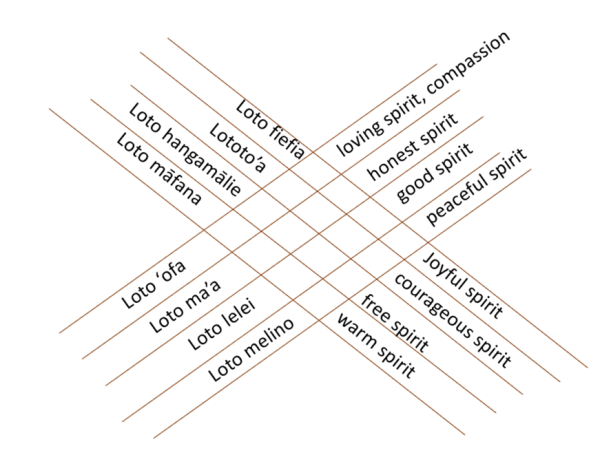
The tapestry of the elements of the Tongan heart
The following list is a resource that defines and describes the elements of the Tongan heart and its application in practice. These can be used as sets of standards when engaging with Tongan children, young people, their families and communities to uphold cultural integrity and professional conduct. (Dr Linitā Manu’atu in her keynote address at the 18th Tonga Research Association Conference shares about Fatumanongi ‘o e Loto’i Tonga & Fakamonū ‘o Tonga.)
| Definition | Application to practice |
|
Loto ‘ofa To have a spirit of unconditional love, compassion, of a caring nature, thoughtful and considerate no matter what the situation. Loto ‘ofa is demonstrated when the heart and mind connect which is manifested in our actions. |
Consider the best interest of the fanau and their culture by:
|
|
Loto ma‘a To have an honest spirit which is encompassing of the truth and what is right. At the heart of loto ma‘a is transparency, clear intentions with no hidden agenda. |
Honesty and transparency in your actions and communications involves:
|
|
Loto lelei To have a good and kind spirit. Loto lelei is harnessed with good will and manner, patience and understanding, showing good intentions. |
Good will and kindness start with our inner self. Your interactions can show deep concern for the wellbeing of fanau and kāinga:
|
|
Loto melino To have a peaceful spirit. Cultivating loto melino requires a heart of gratitude, faithfulness, positive mindset, and calmness amongst tensions. |
Here are some ways to weave a peaceful spirit in practice:
|
|
Loto fiefia To have a joyful spirit. Passion, positivity, and optimism are fruits of loto fiefia. It promotes possibilities and strengths.
|
|
|
Lototo‘a To have a courageous spirit. Loto to‘a encapsulates a willing and courageous heart and not be afraid to speak, stand up and do what is right in a respectful manner. |
|
|
Loto hangamālie To have a free spirit. Integrating loto hangamālie implies one to be open to innovative ideas and learnings but never compromise values and beliefs. |
|
|
Loto māfana To have a warm spirit. Loto māfana embraces inner passion that drives people to move together towards accomplishing shared goals. It is the interconnectivity of ways of thinking, feeling and acting. Tauhi Vā Māfana: Tongan leadership and culture in the New Zealand Public Service, by MK Paea (pages 31 to 32) |
|
The tefito‘i tui or the values of Mo‘ui Fakalata offer guidance to strengthen the way we work and communicate with Tongan fanau and their kāinga. These values are not just about bringing your head but also your heart to the relationship. Fanau and kāinga can sense genuine and authentic engagement in your intent and the way you engage them. Drawing on these values enables you to have a safe relational, inclusive and restorative way of working. As is seen in the diagram, the values are stored in the taufatunga motu‘a area of the fale (the taufatungamotu’a is one of the main beams of the roof structure in the Tongan fale, where Tongans stored their treasures such as fala/mats and ngatu/tapa cloths – refer to Nonu 2016, pages 25 to 28). Everything about Mo‘ui Fakalata is contained within the fale.
The core values of Mo‘ui Fakalata derives from our Tongan cultural values to ensure children reach the optimum value of life and are enriched so that they can thrive.
‘Ofa (love, care, and compassion)
Action and behaviour need to come from a place of love, care and compassion. It is a requirement for ‘ofa to be at the core and must be central in all processes when working with Tongan fanau and kāinga as it helps to facilitate a bond and connection. ‘Ofa can overcome potential oppressive relationships and dynamics. Importantly ‘ofa is essential in building strong relationships and fostering positive outcomes. (See Kalavite 2010, especially pages 34 to 36, for more information on the concept of ‘ofa.)
Application of ‘ofa to practice:
- Shows in one’s action to support or take care of meeting someone’s needs (emotionally, spiritually, psychologically, economically)
- Demonstrate sensitivity and respect for cultural differences
- Connecting with your heart by allowing for time and space
- Communicating in a language that is relational and inclusive
- Actively and attentively listen from the heart
- Acknowledge challenges and difficulties they might be experiencing
- Going beyond, willingness to go the extra mile and doing things without being asked to do, such as addressing the needs of fanau/kāinga that may impact wellbeing (access to support, advocacy)
Faka‘apa‘apa (respect)
Faka‘apa‘apa is about showing respect in your behaviour – verbal and non-verbal interactions.
Faka‘apa‘apa is a written social contract that all Tongans aspire and adhere to in various degrees and contexts. Faka‘apa‘apa begins with a shared understanding that this is relational social contract between two people. Faka‘apa‘apa as much as it is a value must be demonstrated through behaviour, speech, dress code and meeting cultural and familial obligations.
Sustainable livelihood and education in the Pacific: Tonga pilot report (page 67)
Application of faka‘apa‘apa to practice:
- Acknowledge cultural differences and understanding
- Aware of gendered expectations within the family, such as women’s place within the home
- Keeping of certain taboos between members of the family, such as types of language used (taboo for different genders), dress code, roles and responsibilities
- Respect between brother and sister when sensitive topics are being discussed
- Be mindful of the verbal and non-verbal language we use and manner we deliver our message
- Taking lead from the family about how best they would like to proceed or begin a meeting
- Speaking to family at the same level – if they sit on the floor and they offer you a chair, sit on the floor. Take your shoes off at the door, and always acknowledge elders in the house
- Parking – not parking on the driveway
- Listen more and talk less
Tauhi vā (maintaining and looking after relationships)
Tauhi means to look after or take care of, and vā is the social spaces or relationships among people.
Tauhi vā: Nurturing Tongan Sociospatial Ties in Maui and Beyond, by Tēvita O Ka'ili (pages 89 to 114)
It embodies the process, practice, patterns and connections of caring for and protecting relationships and how people relate to one another. Maintaining strong relational ties or connections is important to Tongan wellbeing and an important competency when working with people who identifies as Tongan. Transnationally these relationships may be practised differently by different people in relation to their own socio-cultural needs and expectations.
Application of tauhi vā to practice:
- Build trust by thinking of ways to establish social and meaningful connections
- Create a welcoming warm and safe space by sharing a bit about yourself
- Engaging in friendly talanoa (conversation) to affirm things that are important to them
- Matakāinga is central to tauhi vā (behaving like family, expressed in the value of looking after relationships). Warmth is shown on the face and in your body language
Tongan metaphors of social work practice: Hange ha Pa kuo Fa'u', by Tracie Ailong Mafile'o (pages 140 to 142)
- Understanding mutual respect regarding relationships among kāinga
- Doing due diligence to care for the relationship by taking the time to ask questions, planning, documenting and decision-making process
- Aware that relationships are not terminated
- Validating people’s experiences and positions
- Appropriate cultural consultations
- Clarity about roles and responsibilities
- Being aware of the different challenges fanau/kāinga faces
Anga fakatōkilalo (acting with humility)
Fakatōkilalo means 'is to cause to faka (fall) kilalo (down)'. Fakatōkilalo in the Tongan context refers to being humble with a willing heart to value the welfare of others more and think of oneself.
Tongan metaphors of social work practice: Hange ha Pa kuo Fa'u', by Tracie Ailong Mafile'o
Once a relationship is created or acknowledged, distinct role and purpose can begin to be discussed one step at a time. For example, dressing appropriately, know how to greet and address those you are working with and use appropriate language in context is important.
Application of anga fakatōkilalo to practice:
- Show you have genuine interest in wanting to work with them
- Demonstrate respectful manner by listening and responding appropriately
- Hearing others first before speaking yourself
- Respecting fanau, fāmili and kāinga identity
- Check out, seek permission and approval with family
- Acknowledging your cultural limitations and openness to learn
Fatongia (duty and responsibility)
Duty and responsibility contribute to wellness. This is conducted and motivated by fulfilling one’s commitment and obligation in the home and to the wider community. Each person has a role to play for the collective benefit to all members of the fāmili and kāinga. For Tongans, these are taught and engrained into their lives from an early age. For example, fatongia of children towards their parents and vice versa, honouring the duty and obligations between brothers and sisters, responsibility within the kāinga and through the social structure. It is a great shame if fatongia is not fulfilled, and people take extreme measures to carry out their duty to the utmost best. People’s relationships to one another are identified by the duty and responsibility they play. These duties and obligations may vary from family to family.
Application of fatongia to practice:
- Understanding roles, rank and status that comes with obligations/responsibilities
- Recognition of position and role of each family member and how that may impact or influence the collective family dynamic, decision-making
- Consider connections to the church and wider community
- Accountability and pressure points on wellbeing
- Obligation to maintain relationships
Feveitokai‘aki (reciprocal respect)
Feveitokai‘aki is reciprocal respect which values sharing, cooperation and vital aspect that guides selfless acts of giving and serving others instead of self-interest. Reciprocal respect is relationally formed through mutually affirming interactions. Reciprocal respect for one another promotes mutual accountability which builds the trustworthiness and quality of the relationship. This is where both who are engaged in the relationship feel fairly treated and listened to and acknowledges the strengths and vulnerabilities that people bring to the relationship. When practised well, reciprocity enhances equality within the relationship moving away from dominant individualistic way of working.
Application of feveitokai‘aki to practice:
- To respect and value each other’s feelings and needs
- Looking beyond the working relationship, locating connections, networks, and communities for the benefit of the fanau, fāmili and kainga
- Promote equality in the relationship
- Respecting individuals and families who they are and see their potential
- Acknowledges fanau and kāinga knowledge to co-produce solutions together
Fetokoni‘aki (reciprocity)
The value of fetokoni‘aki is in the action of what one provides, to support, and help each other to work together. This is important as a collective measure to ensure the mobilisation of fāmili and kāinga within the home and community. Fetokoni‘aki is crucial as members are expected to show these qualities in their daily lives. It is about having a willing heart to help with balanced levels of give and take.
Application of fetokoni‘aki to practice:
- Understanding the collective and interdependent values
- Not making decisions in isolation but sharing your thoughts and ideas to reach a common goal
- If the family you visit offer you a cup of tea, next time you visit take a cake or something in return
- Willing to accommodate and be genuine
- Sharing the same feelings, views with fāmili/kāinga in a respectful way
Mo'ui Fakalata practice prompts
Useful words and phrases
Can't find what you're looking for? Try the search bar or view policies.
Social structure
Effective practice with fanau means cultural perspectives and gendered relationship dynamics in the social structure are understood. Any interventions should include ways of being Tongan that is defined by the fanau and kāinga. Social structure and its connections to fanau identity provides:
Relational expectations in the social structure reinforces duties and responsibilities and how interactions are carried out. Traditionally, and today, the Tongan social structure is hierarchical and ascribed by birth. Fanau and kāinga often experience contesting challenges of this structure within new environments.
Of note, a change has been noted to the Tongan social structure to include the emergence of an 'elite' class by which commoners such as government ministers, church ministers, wealthy and educated people are able to claim a space through their academic achievements. From a Tongan lens, social workers need to understand the role of power that as professionals they bring to the working relationship.
The social stratification is distinctive and prescribes action regarding the way people relate and communicate with one another. For example, interactions and languages for communication used for the king differ from those used for a noble or for commoners. These systems prescribe things to be said and things not to be said. At the heart of this social structure and organisation is the significance of kāinga relationships and ties.
Fofola e fala kae alea e kāinga: Exploring the issues of communication regarding Tongan youth suicide in South Auckland, New Zealand
Nofo ‘a kāinga means the dwelling within the family (inclusive of immediate and extended) or the core of the kinship circle. It is also known as the Tongan family structure. Kāinga ties to fanau is important as it encompasses how the home is structured and organised, those that live within but also those who are connected to the fanau and live outside the home. Kāinga highlights significant people with roles and functions. For example, grandparents, aunts, uncles, cousins and so forth. These key roles mobilise extended familial relationships and associated obligations of care and protect the fanau.
Tongan family structure illustrates that kāinga is collective and includes relationships across the broader collective which are reciprocal in nature regardless of kinship ties. From a Tongan perspective, the kāinga can be a mechanism for social workers to detect relationships that often serve as protection, support, accountability to influence positive change for families.
Ko e tangi fai mei he ate: Conceptualising deliberate self-harm amongst Tongan women in Auckland, New Zealand, by Aulola He-Polealisi Fuka Lino
The relationship between members of the kāinga is reciprocal and interdependent, with each member fulfilling an expected role responsibility to one another. While this act of reciprocity is positive, factors have contributed to changes in the family structure which places pressure on kinship ties and fanau. The kāinga can be a protective and risk factor for fanau.
Role distribution and expectations are deeply ingrained in the cultural fabric and traditional values of Tongan people. There is clear division of roles and responsibilities based on gender, age and social status. Each person knows their specific role and has certain expectations to fulfil.
Roles in the kāinga are instrumental in maintaining a sense of unity and harmony. It creates a sense of order and cooperation, which leads to improved wellbeing for all. Roles are closely tied to traditions in Tongan society and are usually passed down through generations, emphasising the importance of family and community ties. By adhering to these roles, individuals contribute to the preservation and transmission of Tongan culture, which is essential for wellbeing.
The kāinga has the responsibility to teach, care and guide children about talangofua (obedience), ‘ulungaanga (expected behaviour) and consequences. First-born sons and daughters hold status and are raised to be aware of responsibility and expectations from an early age – these include looking out for younger siblings and over time. Subsequent children are also taught their roles, responsibilities within and duties to the kāinga. The child’s gender is also significant to legal rights and entitlements. Males have legal privilege over females in land inheritance and succession to the throne in Tonga.