

He Tuluma – Tokelau cultural approach
He Tuluma is an ethnic-specific cultural approach for Va'aifetū that offers all practitioners essential cultural and practice knowledge, skills and behaviours for working with Tokelau children, young people, families, caregivers and communities.He Tuluma
"Ko fanau ko te au o matua (children are the heart of a parent)"
Suria Aukuso, practitioner
He Tuluma is the Tokelau ethnic-specific cultural approach which enables Oranga Tamariki practitioners to build their knowledge, skills and awareness when working with Tokelau tamaiti (children and young people), kāiga (family), caregivers, and communities across child protection, youth justice, adoptions, and all other areas of our practice. He Tuluma cultural approach is an iteration of the framework that was launched in 2015 as part of Va’aifetū. He Tuluma provides social work practitioners an understanding and context of Tokelau cultural knowledge, values, and beliefs in Aotearoa New Zealand.
The opening statement “Ko fanau ko te au o matua (children are the heart of a parent)” highlights that tamaiti (children) are seen as carrying the hopes, legacy, and love of the family into the future. He Tuluma symbolises the treasuring of tamaiti the living expression of kaiga (family) and fenua (land). Their wellbeing reflects the strength of the family. Parents see their tamaiti not only as individuals but as gifts from God, entrusted to them to nurture, protect, and guide with love, patience, and cultural values.
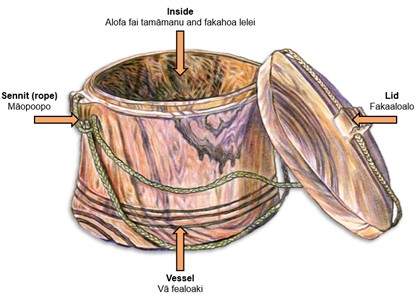
He Tuluma is a treasured cultural symbol for Tokelau people, representing protection, identity, and the bearing of knowledge and responsibility. The tuluma is a wooden sealed container used by fishermen to hold and protect essential and valued items when at sea. A tuluma which falls into the water if the sea becomes rough will float and keep everything inside dry, protected and safe.
As a cultural metaphor, He Tuluma represents preparedness, protection, and knowledge for safe passage, guiding attributes for practice with Tokelau people. Like the tuluma, which protects precious and essential items through turbulent seas, social workers have a duty to protect the dignity, identity and wellbeing of the tamaiti and kainga they serve. He Tuluma reminds practitioners to approach their role with care, humility, and an understanding that every kaiga (family) holds its own strengths, treasures and resilience that must be protected and upheld.
Worldview
Understanding what shapes faka-Tokelau (the Tokelau way) is important for practitioners as it provides unique cultural context that promotes effective practice to ensure safety and wellbeing when working with Tokelau tamaiti (children) and kaiga (family). Faka-Tokelau is central to the Tokelau worldview and places high value on māopoopo (collective unity). There are several elements that form faka-Tokelau. These are embedded in significant ways that construct their way of life based on values, beliefs, customs, rituals and social organisations.
Following are some aspects to consider about faka-Tokelau:
Roles and responsibilities
Every person from tamaiti (children) to elders holds a defined place within the kāiga (family), nuku (village/community) and society and these roles are essential for maintaining harmony, cultural identity and social stability. Roles and responsibilities are shaped by factors such as age, gender, birth order and gafa (genealogy). Elders are respected as knowledge holders and decision-makers, responsible for guiding younger generations, maintaining traditions and resolving disputes. In social work practice, recognising the importance of these roles and responsibilities is critical.
Place of children and young people
Tamaiti (children) hold a sacred and central place as the heart of the kāiga (family), pui kāiga (extended family) and nuku (village/community), and the future for Tokelau people. The presence of tamaiti brings life, hope and continuity to the village. Tokelau social structure is highly communal, with tamaiti holding a significant role and are not independent of the collective. Social workers must recognise and respect the interconnectedness of family, community and culture to ensure that any intervention upholds relational values and strengthens, rather than disrupts, te kāiga (family) and the wider community.
Several key aspects and functions of the social structure enable a holistic approach when working with tamaiti who has connections to Tokelau for the following reasons:
Wellbeing – ola mālolo lelei
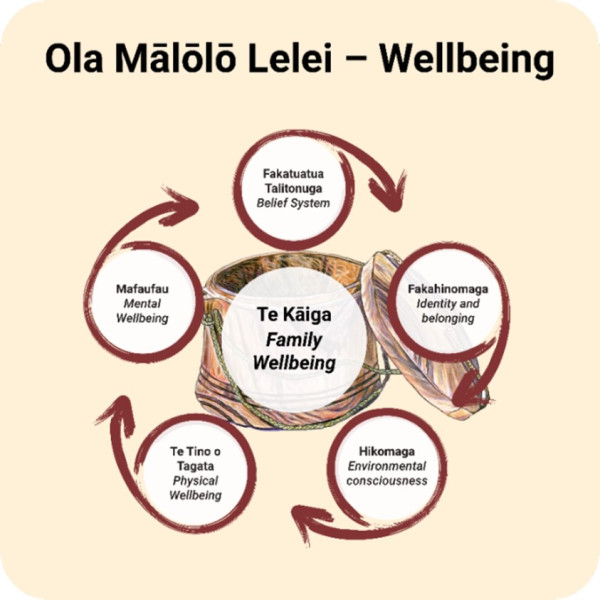
Ola mālolo lelei (wellbeing) is about the holistic wellness of the collective which is deeply rooted in the dimensions of te kāiga (family), fakahinomaga (identity and belonging), fakatuatua / talitonuga (belief system) tino o tagata (physical wellbeing), mafafau (mental wellbeing), and hikomaga (environmental wellbeing). For Tokelau people, if the collective is well, the individual is well. Intertwined with wellbeing is the faka-Tokelau aga-nuku (Tokelau values) that support the wellbeing of kāiga and nuku (village/community).
Understanding safety and wellbeing
Safety and wellbeing from the perspective of Tokelau people is when individuals are protected within the strength of their kāinga (family), nuku (village/community) and culture. The individual is never viewed in isolation – their safety and wellbeing rely on the strength and support of those around them. While Tokelau people value and prioritise collective care, it still acknowledges that individuals must be protected, especially vulnerable members such as tamaiti (children), elders or those experiencing harm within te kāiga (family).
When individual wellbeing is at risk of harm, the response should:
- engage the wider family network to restore safety
- involve the nuku leaders to mediate and guide
- uphold cultural identity as a protective factor
- intervene in a way that avoids isolating the individual from their kāiga and cultural foundations.
| The safety and wellbeing of individuals mean: | Individual safety and wellbeing are at risk when there is: |
| They are connected to their kāiga (family), supported by family relationships. | Breakdown of kāinga relationships or community ties. |
| Their emotional, spiritual and physical wellbeing is nurtured. | Loss of cultural connection, language or traditions. |
| They feel a sense of belonging within the nuku (village/community). | Separation from kāiga (family) or nuku through systems without cultural consideration. |
| Their cultural identity, language and traditions are respected and upheld. | Disrespect or failure to recognise a person’s place within the social and family structure. |
| They are protected not only from physical harm but also from disconnection, isolation or loss of identity. | Exposure to violence, neglect, sexual or emotional abuse without family or community intervention. |
 Practice consideration
• Social workers must assess individual safety with an understanding of cultural, spiritual and relational factors.
• Interventions should prioritise keeping the individual connected to kāiga (family), culture and nuku (village/community) where safe to do so.
• Removing individuals from harmful situations must be balanced with efforts to preserve identity and connections.
• Strengthening the pui kāiga (extended family) is seen as strengthening individual safety.
Application to practice
 He Tuluma cultural approach acknowledges that culture is ever evolving and that families may be at different various stages of an evolutionary journey or cultural continuum. Some families may be quite traditional and adhere to hierarchical relationship structures. However, others, influenced by Aotearoa New Zealand culture or other factors, may be more egalitarian and permissive towards the voices of tamaiti (children).
He Tuluma offers a powerful and culturally responsive way to deepen understanding – it brings richness, connection and relevance to practice. The imagery for He Tuluma anchors social work practice in the cultural worldview of Tokelau people.
Relational concepts
Understanding relational concepts is essential for social workers because relationships are central to working effectively and respectfully with Tokelau families and communities where wellbeing is collective, spiritual and deeply relational. It is also important to recognise that safety is a culturally shaped and relational concept. For Tokelau communities, safety extends far beyond physical wellbeing – it includes spiritual, emotional, cultural and collective dimensions.
Aganuku (values) and their application to practice
Grounding practice in values that is central to Tokelau people ensures that interventions are not only sound but culturally safe, respectful and empowering. Understanding these values will help social workers to understand behaviour in a cultural context.
Practice prompts
 The He Tuluma practice prompts:
- cover important principles and values
- explain what our practice should include for each one
- provide a set of reflective questions.
Useful words and phrases
Sources for the Tokelau cultural approach
Tuisano, H. S. (2021). Māopoopo: a socio-cultural and collective understanding to improve wellbeing amongst Pacific people in Aotearoa/New Zealand [Doctoral dissertation, Massey University].
Kupa, K. (2009). Te Vaka Atafaga: A Tokelau assessment model for supporting holistic mental health practice with Tokelau people in Aotearoa, New Zealand. Pacific health dialog, 15(1), 156-163.
Kele-Faiva (2010). The voices of Tokelau youth in New Zealand: Na mafialeo ona Tupulaga Tokelau i Nui Hila [Masters thesis, Victoria University]. Open Access.
Tokelau Cultural Advisors 2024, Oranga Tamariki (Imagery and metaphor).
Can't find what you're looking for? Try the search bar or view policies.
Social structure
It requires recognising that tamaiti (children) ola mālolo lelei (wellbeing), including safety, and solving issues within the kāiga (family) happens within pui kāiga (extended family) systems, where decisions are made collectively. Interventions that respect and engage with these kinship structures are more likely to be effective, culturally safe, and sustainable.
Kāiga refers to the family system that is the foundation of social life, identity and wellbeing for Tokelau people. Kāiga include nuclear family, grandparents, aunties, uncles, cousins and even close community members who are considered family. It is through the kāiga that values such as fakaaloalo (respect), alofa fai tamāmanu (compassion), māopoopo (collective unity) and spiritual faith are taught. The strength of the kāiga ensures that no one is left isolated – when one member suffers, the whole family feels the impact; when one thrives, the whole family celebrates.
Pui Kāiga reflects the extended family which serves as a protective circle, providing emotional support and guidance, cultural teachings, and practice care. For social workers, understanding the role of pui kāiga means family support systems are deeply collective. The wider kāiga must be engaged and recognised for their cultural roles and relationships that shape decisions. Strengthening the pui kāiga promotes wellbeing and cultural identity.
The nuku (village) is grounded in collective responsibility, respect and the interconnectedness of kāiga (family) and community. The nuku is seen as both a physical and social space where people live, work, worship and raise their tamaiti (children) together. Safety within the nuku is not viewed solely as individual physical protection, but as a broader concept that includes emotional, spiritual and cultural safety. It means ensuring that every member – especially tamaiti and vulnerable people – feel valued, respected and cared for. This is upheld through kin ties, the teachings of elders and the expectations that everyone contributes to the welfare of others. Harmful behaviours such as violence, neglect or disrespect are seen as threats to the unity and wellbeing of the entire community, not just the individuals. When issues arise, the nuku often responds collectively through dialogue, guidance from elders and culturally appropriate interventions to restore harmony.