

Epa Faliki – Tuvalu cultural approach
Epa Faliki is an ethnic-specific cultural approach for Va'aifetū that offers all practitioners essential cultural and practice knowledge, skills and behaviours for working with Tuvalu children, young people, families, caregivers and communities.Epa Faliki
"E tupu te livaliva i te fale mo te fenua (a child grows within the home and the community)"
Tuvalu proverb
This proverb emphasises the collective responsibility of families and communities in nurturing and guiding children. This highlights how a child's wellbeing and resilience are shaped by both their immediate family and the wider society.
Epa Faliki represents our approach to working with Tuvalu tamaliki (children and young people) and kaaiga (family).
Epa Faliki is grounded in the values, traditions and collective strength of the Tuvalu fakapotopotoga / kuminiti (community) to ensure safety and wellbeing of its members. It recognises that the safety and wellbeing of Tuvalu tamaliki must be upheld in ways that connect with who they are. This cultural approach offers Oranga Tamariki practitioners foundational knowledge and skills for working with Tuvalu tamaliki and kaaiga, caregivers and communities, across child protection, youth justice, adoptions and all other areas of our practice.
Epa Faliki is structured to support practitioners’ cultural awareness, to recognise cultural distinctions, understand expectations, accountability and safety to ensure interventions are delivered with empathy, dignity. The cultural approach is structured to provide effective and meaningful change for tamaliki, upholding their dignity, strengthening their kaaiga and promoting long-term olaga tokagamalie (wellbeing) within a statutory context.
"Lalaga a te Epa Faliki mo fakanofo a te tamaliki mo ona ola puipui (the weaving of the Sacred Mat is for the wellbeing and protection of the child)"
Epa Faliki symbolises the strong foundation from which tamaliki (children) develop. It carries a deeper metaphorical meaning that is symbolic of safety provided for children to ensure sustainability and comfort. The Epa Faliki is where the tamaliki rest, where they lie while being fed, taught and cared for by their parents and kaaiga (family). Epa Faliki is used to place emphasis on the responsibility of families, communities and systems to create a strong and safe environment for children to grow and thrive. This cultural approach is underpinned by a collective duty, where tamaliki are nurtured within an extended family and fakapotopotoga / kuminiti (community) network.
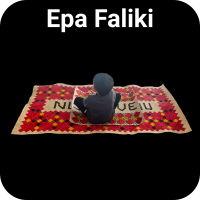 ‘Epa’ refers to a board, plank or platform and ‘Faliki’ are mats that hold cultural significance. When a mother is pregnant, Tuvalu cultural practices and processes are enacted by the women of kaaiga (family), pui kaaiga (extended family) and fenua (individual island) in preparation for the birth of the child. An Epa Faliki is created for the coming birth and blessing, and the Epa Faliki is gifted to the baby to carry with them through life. The women of the kaaiga and the fenua play an important role in the preparation and making of Epa Faliki.
Epa Faliki upholds the belief that tamaliki (children) are a gift from God, and a blessing to matua (parents), te kaaiga (the family, including extended) and the fakapotopotoga / kuminiti (community). The safety and wellbeing of tamaliki is ‘sacred’, making the care and protection of and love for tamaliki the priority, not just for matua (parents) but also te kaaiga and the surrounding community.
Worldview
The Tuvalu worldview is deeply rooted in collectivism, intergenerational knowledge, spirituality and fakaaloalo (respect).
These shape how people perceive relationships, responsibility that contribute to identity, belonging and olaga tokagamalie (wellbeing). Understanding Tuvalu worldview is essential in any engagement with children, young people, families and communities that have ties to Tuvalu. Practitioners can build culturally responsive approaches that empower and ensure the best outcomes for children and young people.
Aspects of worldview that are important to Tuvalu people:
- collective identity
- respect (fakaaloalo) and reciprocity
- spiritual and cultural foundations.
Collectivism is crucial to maintaining the traditional customs, values and belief systems of Tuvalu society.
It is expressed through working collaboratively, sharing resources, skills, and aiding those in need within their fenua (individual island), fakapotopotoga / kuminiti (community) and kaaiga (family).
It illustrates the importance of how Tuvalu people work together for the greater good.
 Practice consideration – Decisions about tamaliki are made with input from elders and family members, not just the parents. Services and interventions should engage the wider family and fakapotopotoga / kuminiti (community), ensuring solutions are safe, culturally appropriate and sustainable.
Respect for elders, traditions and authority is central to the Tuvalu worldview.
Relationships are reciprocal, supporting others and not just an obligation but an expectation.
 Practice consideration – Child protection, youth justice and adoptions approaches should honour these values by working in partnership with families and elders, rather than imposing external solutions.
Christianity plays a significant role in Tuvalu life, influencing moral values, discipline and caring for one another.
Cultural traditions such as fatele (traditional gatherings) and inati (shared resources) have a spiritual underpinning and reinforce the importance of unity and fairness.
Understanding these foundations helps ensure that interventions align with the spiritual and cultural beliefs of the fakapotopotoga / kuminiti (community).
Practice consideration – Use mana-enhancing approaches when working with Tuvalu kaaiga (families), recognising they have rich cultural strengths that should be acknowledged and built on. Consider spiritual and cultural needs to ensure that services respect these. Most Tuvalu people are connected to a church and their connections to church fakapotopotoga / kuminiti (community) is strong. Elders, church and fakapotopotoga / kuminiti networks can provide cultural support and advice to kaaiga.
Roles and responsibilities
Tamaliki (children) hold a central and cherished position reflecting the collectivist values of Tuvalu society. Their upbringing is deeply embedded in extended family networks, fakapotopotoga / kuminiti (community) responsibility, and cultural traditions. Tamaliki are seen as precious treasures who embody the future of their kaaiga (family) and fakapotopotoga / kuminiti. Their wellbeing is interconnected with collective social structures that emphasise care, respect and cultural continuity. Conflicts involving tamaliki are often resolved within the family with emphasis on restoration and reconciliation. Tamaliki views are, for the most part, represented by adults.
With the migration to Aotearoa New Zealand, the influence of western thinking, and legislation support, Tuvalu tamaliki are exercising their right to express their own views. This shift can often create tension in the tamaliki–matua (children–parent) relationship.
Practice consideration – When there is tension within the tamaliki-matua (child-parent) relationship it is important for practitioners to ensure that the voices of tamaliki (children), their views and aspirations, are heard by kaaiga (family) to support any decisions and plans.
Tuvalu tuu mo aganuu (Tuvalu values) and their application to practice
Tuvalu tuu mo aganuu have significant implications for social work practice, especially in areas like child protection, youth justice and adoptions. When engaging and building relationships with tamaliki (children) and kaaiga (family). Practitioners should explore and understand the cultural context and importance of values within each kaaiga. Social workers working with Tuvalu communities must integrate these values into their approach to build trust, enhance cultural responsiveness and support effective interventions. It is important for practitioners to understand that Tuvalu values are expressed in the way they socialise and interact with each other. Tuvalu values play a crucial role in shaping appropriate ways of engagement and understanding of Tuvalu culture.
Wellbeing
Olaga tokagamalie (wellbeing) is the Tuvalu concept of wellbeing – ‘olaga’ means life and ‘tokagamalie’ means safety, protection, wellness – a secure life or a life where one feels safe and secure. It means a life where we have strong spiritual values and beliefs and good physical health. A life where people live peacefully and trust in their leaders. A life where there is more than enough food for everyone. A life where values of love, respect, care and share are ingrained in how people live, in their relationship with each other, with families and the community. A life where people have access to everything.
Dimensions of wellbeing and signs of concern
Olaga tokagamalie comprises 5 dimensions that contribute to an overall state of wellbeing and, when at their combined optimum, are fundamental to a happy, peaceful and safe life for Tuvalu people. Understanding these dimensions builds understanding of harm, safety and protection for tamaliki (children) and kaaiga (family).
Understanding signs of concern is crucial because it helps ensure the protection and support of individuals, particularly children within their cultural and social context. Wellbeing for Tuvalu people is represented by the interconnectedness to their communal values and traditional practices. Recognising concerns allows for timely intervention while respecting strengths and creating safe space for discussion and resolution.
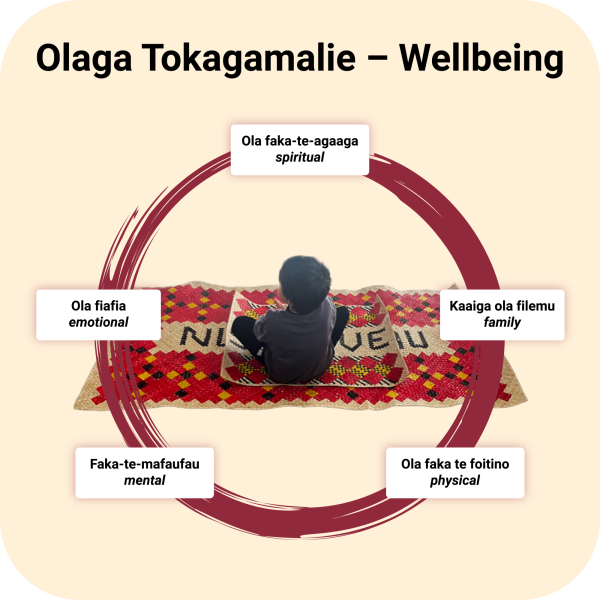
Diagram: Epa Faliki - wellbeing.
The state of wellness for the family is important as this reflects the holistic health of its members (immediate and extended family) living in harmony.
A harmonious family means having a strong sense of love demonstrated by behavioural exchanges that show fakaaloalo / aava (respect), alofa (deep concern and affection), fakatalitonugina (being trustworthy), fealofani (harmonious relationships), and faka fesoasoani (helping one another).
Working together to create and maintain peace and harmony is essential for the wellbeing of each member and the collective.
Practice consideration – Evening devotion is one of the routine and main ways in which Tuvalu kaaiga (family) maintain wellness, address concerns and support each other. It is in this environment that roles and responsibilities are clarified and reaffirmed.
Signs of concern
- Family distress.
- Trauma and conflict within kaaiga (family).
- Isolation from kaaiga support.
- Traditional worldviews, values and beliefs and western ideologies between tamaliki (children) and kaaiga causing tensions within kaaiga.
- Lack of understanding Aotearoa New Zealand laws, policies.
Kaimahi talks about wellbeing
Application to practice
Engaging effectively with Tuvalu tamaliki (children) and their families requires a culturally grounded approach that acknowledges the strength and foundations of who they are. Below are practical strategies that practitioners can use in their engagement, assessment and intervention.
Epa Faliki practice prompts
The Epa Faliki practice prompts:
- cover important principles and values
- explain what our practice should include for each one
- provide a set of reflective questions.
Useful terms and phrases
Sources for the Tuvalu cultural approach
Aselu, B. (2015). A Tuvaluan concept of well-being: reflection on national planning-Te Kakeega II [Doctoral dissertation]. Auckland University of Technology. (See p.94)
Panapa, T. (2014). Ola Lei: Developing healthy communities in Tuvalu [Unpublished doctoral dissertation]. University of Auckland. (See p.84)
Tufala, S. (2018). Tuvaluan People's Explanations of Pacific Underutilisation of Mental Health Services [Doctoral dissertation]. Auckland University of Technology.
Yates, O. E. T., Groot, S., Manuela, S., & Neef, A. (2023). “There's so much more to that sinking island!” Restorying migration from Kiribati and Tuvalu to Aotearoa New Zealand. Journal of Community Psychology, 51, 924–944.
Can't find what you're looking for? Try the search bar or view policies.
Social structure
Tuvalu social structure is fundamental to the wellbeing, resilience and identity of its people.
It provides a framework for the organisation of their life in society, family, and fakapotopotoga / kuminiti (community) relationships, ensuring social cohesion and continuity in the face of challenges, such as climate change that is happening in the homeland, changes to the economy, and migration.
For social workers, understanding Tuvalu social structure is essential for effective practice. Interventions must align with family-centred, community-led approaches, recognising the role of extended family and local leaders in decision-making.
The social structure is interconnected and consists of the following:
The kaaiga includes the extended family and kinship group, often living in the same dwelling. The household is headed by the person who holds pule (head of the family) who is usually, but not always, the eldest active male in the household. The father is the usual head of the household. A widow or single mother who is the eldest in the household may be the pule, and she may choose to delegate her responsibilities to her eldest son. The rest of the kaaiga is responsible for implementing the decisions of the pule. Grandparents can live in the home to support and help matua (parents) with the care of tamaliki (children) while parents work.
Brother and sister relationship
There is a sacred relationship between brother and sister. The sisters must not be provoked or embarrassed by the brother. In traditional culture, it is forbidden for the brother to spill the tears of his sister (to make his sister cry).
Pui kaaiga consists of relatives, aunts, uncles, cousins, sai (non-kin) relationships and grandparents who may not be living in the home.
First cousin relationships
Male/female first cousin relationships (for example, a female and her male first cousins or a male and his female first cousins) are tapu (sacred) and more significant than the brother–sister, sibling relationships. Traditionally, if a male sees his female first cousin walking towards him, he will turn and go in another direction to avoid their paths crossing. This exemplifies the tapu nature of their relationship, whereby the male cousin avoids violating tapu through unchaperoned contact with his female cousin.
The relationships between males and their female first and second cousins, and the relationships between females and their male first and second cousins, are important. Male cousins will rise to occasions when needed to assist or protect their female cousins. These relationships also have more significance than sibling relationships. Their bonds are closer than siblings.
The tuagane (sisters and female cousins) are venerated by their brothers (and by extension, male cousins). These relationships can lead discussions and provide support, care and protection of tamaliki (children).
Sai relationships – non-kin
These relationships hold huge significance in Tuvalu culture. Sai means to tie, referred to the non-kin connections of non-blood brothers and sisters. This bond is stronger and higher ranking than blood siblings, such as sai taina (non-kin sister), sai tuagane (non-kin brother), sai (non-kin) grandparents. Sai grandparents’ relationships are for life – they have a strong connection and relationship that carries through their children and grandchildren.
Mother’s tamaliki and maternal uncle
There is a strong relationship within the tuaatina (the relationship between a mother’s brother and her child). There is an expectation of uncles, regardless of the hardship or danger involved, to help his sister’s children when asked.
Paternal aunts
Paternal aunts carry the identity, connection and genealogy of the kaaiga.
Matua ofo (Godparents)
The role and relationship of matua ofo (godparents) are another significant Tuvalu relationship on a specific fenua (island) – for example: Nanumea – this relationship is highly respected as part of their social structure.
There are 9 fenua (island atolls and coral islands) that make up Tuvalu: Nanumea, Nanumaga, Niutao, Nui, Nukufetau, Vaitupu, Funafuti and Niulakita. Tuvalu means ‘eight islands standing’ because Niulakita, the smallest atoll, is considered part of Niutao Island. Identity and belonging for kaaiga (family) is their connection to their fenua. Each kaaiga is linked to a fenua and each fenua has their own church. The bond with one’s fenua is often more significant than being known as Tuvalu.
Tuvalu people living in Aotearoa gather as kaaiga, fenua (individual island), kaulotu (church congregation) and atufenua (nation). Each individual belongs with at least one of these collectives. Leaders of fenua, kaulotu and atufenua are elected by individuals in those groups, so hold relative influence over members.
For practitioners, it is important to know which fenua the kaaiga are from as each fenua have their own cultural practices and ways of being. For example, matua ofo (Godparents) are not established or recognised relationships across all fenua.