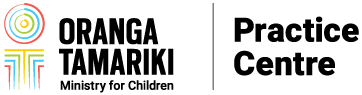

'E Kaveinga – Cook Islands cultural approach
'E Kaveinga is an ethnic-specific cultural approach for Va'aifetū that offers all practitioners essential cultural and practice knowledge, skills and behaviours for working with Cook Islands children, young people, families, caregivers and communities.'E Kaveinga
E ivi no toku nei ivi,
E kiko no toku nei kiko,
E toto no toku nei toto
E tuatua rongonui ki rota ite tangata Polinetia, te tuatua o Maui. Ko Maui nei, e mana maata tona mei tetai o te au atua taito. E tuke maata tona mei tona au taeake. E te au angaanga tana i rave e mea umere tikai. E ravakai aia i tona tupuanga, e koia katoa tei uti mai i te au enua o te pae moana Polinetia, ina te tuatua taito ei. E tamaiti inangaro ia a Maui e tona tupuna e Hina-te-Papa, ko tei ako e tei oronga i te pakari kiaia.
Teia te pe'e a Hina-te-Papa i te karanga ki tana mokopuna Maui no tona utianga mai ia Havaiki mei raro i te moana:
To riri to
Tokomiti tokomiti
Tokofeta tokofeta
Ha ha ha te henua
Tu tu tu Maui
Maui is a major folk hero in Polynesian myth. The story of Maui has been passed down from generation to generation. He was the son of a god and possessed magical powers that enabled him to achieve many great feats, such as snaring the sun with a net he made from his sister’s hair so we could have more hours of daylight.
Maui and his brothers were renowned fishermen. But Maui was different from his brothers. While they were content with life as it was, Maui was always searching for something better.
His greatest feat was the fishing up of Havaiki – the land many Polynesians refer to as the homeland of their origin. Maui, however, could not have achieved this feat without the help of another family member – his grandmother, Hina-te-Papa, who later chanted words of wisdom and encouragement in praise of Maui’s achievement.
The story of Maui embodies positive cultural messages about family relationships, family collaboration, strength, skill and courage in facing new challenges, overcoming them and being successful. Maui’s success in surfacing land from the depth of the sea signalled a new beginning. Like the story of Maui, ‘E Kaveinga is concerned with kinship, new beginnings and opportunities for positive change and growth. The family – that is, ngutuare tangata (nuclear family) and kopu tangata (extended family) – forms the basis of Cook Islands culture. Our work with Cook Islands children, young people and their families should strengthen and empower the collective to care, protect and nurture their children and young people.
As the Cook Islands cultural approach in Va’aifetū, ‘E Kaveinga:
- makes a specific contribution to the integration of Pacific knowledge, culture and social work practice in pursuit of best outcomes for Cook Islands children who come into contact with the child protection, youth justice and adoptions systems in Aotearoa New Zealand
- acknowledges that culture is ever evolving, and that Cook Islands families adapt in different ways to living in different cultural environments. Assimilation occurs across a continuum, and families will be at different stages of that evolutionary journey, from being immersed in a traditional worldview and way of being to being fully assimilated to papa’a (western) ways. Traditional and contemporary families can be defined by structure, roles and responsibilities, functions, decision-making and child rearing, and the values and approach attached to each of these will vary across the continuum
- provides deeper understanding of the cultural context of ora’anga meitaki (wellbeing) through Cook Islands customary ways and way of life.
Worldview
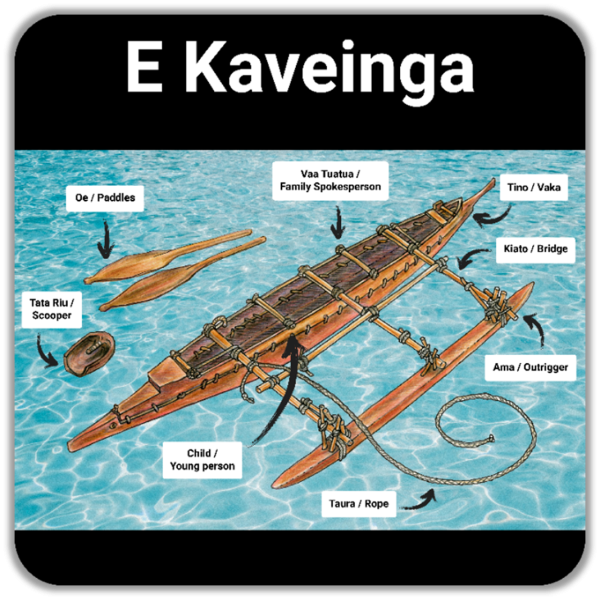
A Cook Islands worldview is informed by values, beliefs and behaviours that permeate all aspects of functioning and ways of being, thereby contributing to the ora’anga, or way of life, of the individual and the collective. This incorporates a collective philosophy that places significant value on individuals' participation in, and contribution to, a larger group, such as family, church, community. In these groups, everyone has a role to play and recognises, supports and complements the roles of others. While individual achievement is valued, the importance of a person’s place within their family and community is still significant – an individual functions as part of a collective rather than solely for themself.
A network of relationships, built on values such as obedience, respect, order, service and reciprocity, contribute to the viability and survival of this collective way of life. Family connections and papa’anga (genealogy) are a core value, and spirituality also features strongly here as safe and balanced relationships with one’s ancestors, as well as one’s Atua (God), are an integral part of this network of relationships.
Connections/relationships and community cooperation are key to achieving and maintaining wellbeing.
The following values are at the foundation of Cook Islands society and permeate all aspects of its functioning and being.
Wellbeing – Ora’anga Meitaki
From a Cook Islands wellbeing perspective, the best interests of the Cook Islands child is embodied in the collective responsibility of kopu tangata (extended family) and communities around the child.
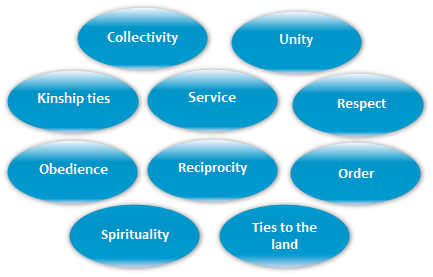
A holistic understanding of wellbeing is expressed through the term ora’anga meitaki, which refers to life lived to its highest potential in good circumstances. Ora’ means life and ora’anga is the process of living. Combined with meitaki, which translates as everything is good, ora’anga meitaki refers to living a good life. The common Cook Islands greeting ‘kia orana’ encapsulates this notion of wellbeing as a shared aspiration for all by extending a blessing ‘may you live long’ or ‘may you live a long and fulfilling life’ to one another. The greeting reflects the values Cook Islands people hold close for their individual and collective wellbeing.
Wellbeing is achieved through the care and maintenance of the collective expressed though papa’anga (genealogical) connections or relationships and the fulfilment of roles and duties attributed to these. These values and practices are embedded in ākono’anga Māori, the culture and way of doing things that is uniquely Cook Islands Māori.
Three key concepts embody a holistic representation of ora’anga meitaki
These are interrelated concepts that embody all aspects of ora’anga meitaki, and the ability to live a good life in good circumstances relies on ora’anga mou, a balance of life where kopapa, vaerua and ngakau needs can be fully met.
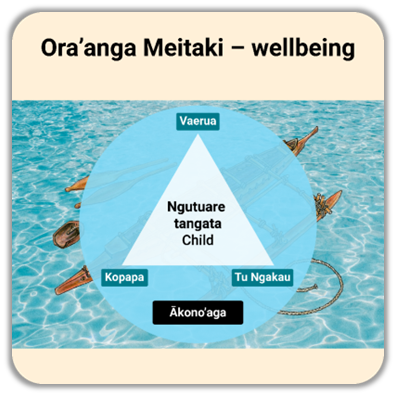
Ākono’anga Māori encapsulates the cultural practices and beliefs of Cook Islands people, their protocols, values and customs, which support all aspects of wellbeing. This includes collective care and responsibility implicit in connections/relationships, roles and accompanying duties to each other and the collective.
Ākono’anga Māori holds the key for holistic solutions and restoration when harm has occurred or is occurring or there has been offending by the child and the ora’anga of ngutuare tangata (nuclear family) and the child have been impacted. Importantly though, the transformative application of ākono’anga Māori depends on its relevance to time and environment. Effecting change for the child and ngutuare tangata when harm has occurred, or is occurring, relies on understanding the motivation for behaviours, and contexts for circumstances, contributing to this.
Pacific-Indigenous social work theories and models, by Mafile'o, Mitaera and Mila
Ākono’anga o te ngutuare refers to the specific expression of ākono’anga in the household (‘what happens in the home’) and this can vary across ngutuare tangata according to where ngutuare tangata are located on a continuum from traditional to contemporary. It is important for the social worker to understand these differences and explore with ngutuare tangata their ākono’anga in order to work effectively with them.
 Practice consideration – Physical discipline is often used by Cook Islands parents to teach children and young people what is acceptable behaviour and what is not. Tolerance of physical discipline is still a much-debated topic in Cook Islands society (biblical references are often used to support or oppose this form of discipline). However, in Aotearoa New Zealand, physical discipline is illegal and unacceptable. Parents who believe in the use of physical discipline as a means of control and teaching their child or young person how to behave should be supported in the use of more positive methods of discipline. Understanding the parents’ motivation and beliefs around this is critical as what supports genuine change is not the motivation (which is to teach acceptable behaviour) but the means of achieving this – that is, re-educating and supporting parents to teach acceptable behaviour in positive rather than harmful ways.
 Practice consideration – Sexual abuse and sex related matters including sex education are sensitive topics and not comfortable issues of discussion. Discussion must be managed in a sensitive way and the use of papa’a (western) terms should be done with care as they can sometimes be viewed as offensive. Use appropriate terms wherever possible, e.g. sexual abuse – kanga taukore ite kopapa tamariki me kare amirimiri. If the alleged perpetrator of sexual abuse is a parent, and in other circumstances where a cautious approach is required, it is often preferable to seek the advice of a female family member (such as a mother, grandmother, or aunt) first. Obtain cultural advice about the appropriate terminology in a particular Cook Islands dialect (there are eight dialects used in the Cook Islands).
Kaimahi talks about wellbeing
Application to practice
- Te au pirianga refers to the relationships between people that contribute to the reciprocal network of the collective. Family is the foundation of Cook Islands society, tying its people to their land and culture. Cook Islands people are collective by nature. Individuals contribute to a larger group, such as family, village, island, church and community, giving a strong sense of belonging to each. Respect, obedience, reciprocity and service are important values that maintain relationships and the wellbeing of the collective. As a collective society, Cook Islands people take care of each other – putting others first and caring for elders and children as valued parts of families and communities is a way of life. Reciprocity, respect, obedience and service is demonstrated through the mutual care and responsibility towards and between families, church and community.
- When people say 'it takes a village to raise a child', this demonstrates pirianga – children belong to everyone, 'my sister’s children or my neighbour's children are my children', there is a collective responsibility for their care and wellbeing.
Practice consideration – A social worker must be able to identify, access and utilise Cook Islands networks during the social work process. A Cook Islands child belongs to an extensive network – links with family, village, tribe, and island are the basis of a child's support and development.
Practice consideration – Under normal circumstances, Cook Islands children are represented by their parents or other adult family members and are not expected to contribute to issues affecting the family. However, the role of children is changing. It is becoming more acceptable for them to speak in less formal situations if authorised by their parents or other elders. Cook Islands children are also part of an extended family and community network. Valuable information can be obtained from adult members of this network.
The concept of turanga acknowledges who you are in the collective, your position and standing and the role accorded to you because of that. In Cook Islands society, everyone has turanga – one’s place in one’s family and community is important. Everyone has a role in the collective that recognises, supports and complements the roles of others. A person’s role may be different across family and community – for example, you can be a parent, a grandparent and mataiapo (head of sub-tribe) at the same time and each of these positions will offer different things for the collective. It is important for individuals to understand their turanga and to recognise the turanga of others so they can be confident in who they are, what is expected of them and what to expect of others.
Cook Islands people believe that children are a gift from God – thus the turanga of children is one of the most precious and the extent of this can be further influenced by birth order or being a namesake of an endeared person.
It is important for the social worker to know not only who resides in the home and who is connected to the child but also their role in the family. In most Cook Islands families in Aotearoa New Zealand, parents are responsible for decision-making for their children. However, extended family members (especially elders and more senior family members) are also influential in supporting, advising and monitoring these decisions.
Practice consideration – The parents’ roles within the family are complementary. Women are influential in decision-making and often take a shared role with their husbands as providers for the family. Men have precedence and a higher profile in many positions of responsibility and power in Cook Islands society, but they are also taking on a greater role in the domestic routines in the home. In most situations, both parents should be approached about concerns. With more sensitive issues, such as sexual abuse, initial contact with an appropriate adult female family member (such as the mother) may be required.
Practice consideration – If you are visiting with an elder from the ngutuare tangata (nuclear family) community, then the elder should take the lead role in the interview. (Agreement and clarification of roles that the social worker and community person will undertake is an important step in planning for the visit to ngutuare tangata.)
Peu refers to a shared and accepted way of life, or characteristics of a group of people defined by its culture – that is, its language, art, values and customs.
Te Peu e Te Akonoanga Maori | Cook Islands Ministry of Education (page 10)
Te peu enua relates specifically to the individual islands of the Cook Islands. Therefore, te peu enua is the ‘Cook Islands way of doing things’ from the unique perspective of a particular island.
Practice consideration – Listen to and talk through any areas of conflict for ngutuare tangata. Using their Cook Islands dialect and the appropriate Cook Islands terms to describe concerns, knowing the correct protocols and demeanour, involving a respected member of ngutuare tangata community as mediator and using familiar media such as biblical quotations and community contacts are useful means of manging conflict. This process should not be rushed, especially in difficult situations. Check the ngutuare tangata understanding of the issues. Listen to and acknowledge individual views expressed by family members and give time for debate on the issues until common agreement is reached.
'E Kaveninga practice prompts
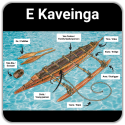 The 'E Kaveninga practice prompts:
- cover important principles and values
- explain what our practice should include for each one
- provide a set of reflective questions.
Useful words and phrases
In keeping with the message about the importance of links to islands of origin, this section includes dialects (more will be added).
Can't find what you're looking for? Try the search bar or view policies.
Social structure
The Cook Islands consists of 15 islands, with 9 different dialects. Rarotongan (or Cook Islands Māori) is the main dialect. Each island has its own identity and social structure and, while there are some similarities between customs and protocols, significant differences exist. Te peu enua refers to the unique expression of cultural practices and protocols of each island. The family's enua anauanga (island/s of origin) and extended family are key identifiers – noting, however, that families have blood links to people from different areas.
Pre-Christian Cook Islands society had a very regimented structure, with everyone knowing their place within the tribe, and understanding their obligations and responsibilities. The ariki (high chief) was paramount and the voice of the ariki was the law of the tribe. Below the ariki were various tribal leaders, mataiapo (head of sub-tribe) and rangatira (sub chief), each of whom had responsibilities within their respective tribes. Below these tribal leaders were the various members who made up the population of the tribe.
Cook Islands society today is still based on a hierarchical, tribal structure with various levels of power and authority. In some islands, the hierarchical structure of ariki, mataiapo, rangatira is still influential in the vaka tangata (tribe). The vaka tangata consists of a collection of kopu tangata (extended family) from a particular area (these families are connected through a common ancestor).
The ariki, as a traditional leader, accordingly maintains a prestigious position within the community. The ariki's relationship with the community, though, has a dual function. On one level, the ariki receives services, goods and kudos for the position they hold. But in return for this power and respect, the ariki is also expected to carry out services for their community, such as settling disputes and officiating at ceremonies. The mataiapo holds a responsible position in the community and is also expected to carry out certain duties for the ariki.
Ngutuare tangata (nuclear families) are linked to a particular island and enua tangata (people from that island), vaka tangata (tribe), oire (village) and kopu tangata (extended family). In some islands, however, the vaka tangata is no longer part of the structure.
Influential traditional leaders, such as mataiapo and ariki, are mainly based in the Cook Islands. Significant contact people in Aotearoa New Zealand can be senior family members of kopu tangata, and community members such as orometua (ministers), ta’unga (healers) and community group leaders.
These links are part of the child’s identity and the basis of their support, development and ultimately wellbeing. Knowledge of the child’s genealogy is important to identify maternal and paternal links and should be explored to inform a wider search for family or community participation and support.
It is important to be able to access and utilise this network in practice – for example, in the process of safety planning, family group conferences (child protection, youth justice and adoptions), or exploring care arrangements. Efforts to identify leaders, elders and other significant persons within a family's network – the family's enua anauanga (island/s of origin), vaka tangata and kopu tangata – should be explored through the appropriate Cook Islands networks. In Rarotonga, for instance, there are 3 tribal areas, known as vaka – Takitumu, Puaikura and Te Au o Tonga. Each vaka is subdivided into villages or oire – Takitumu has 3 villages (Matavera, Ngatangiia and Titikaveka). Families are identified with particular areas and have blood links with other people from within the vaka.