Page URL: https://practice.orangatamariki.govt.nz/practice-framework/whai-oranga/vaaifetu/ribanakin-te-ataei-n-ana-te-utu-kiribati-cultural-approach
Printed: 28/10/2026
Printed pages may be out of date. Please check this information is current before using it in your practice.
Ribanakin Te Ataei n Ana te Utu – Kiribati cultural approach
This ethnic-specific cultural approach for Va'aifetū offers all practitioners essential cultural and practice knowledge, skills and behaviours for working with I-Kiribati children, young people, families, caregivers and communities.
Ribanakin Te Ataei n Ana te Utu
Kateira ma rabakaura bon kinaakira. Our culture and knowledge are our identity.
Ribanakin Te Ataei n Ana te Utu aligns with the Oranga Tamariki practice approach, which is framed by te Tiriti o Waitangi and based on the mana-enhancing paradigm for practice focusing on wellbeing and safety. This cultural approach offers Oranga Tamariki practitioners foundational knowledge and skills for engaging with I-Kiribati ataei (children), te roro n rikirake (young people) and their te utu and te kaainga (immediate and extended family), caregivers and communities across child protection, youth justice, adoptions and all other areas of our practice. (Throughout this guidance, we use ataei as inclusive of te roro n rikirake.)
Ribanakin te ataei n ana te utu means ‘nourishing the child in the family’. For I-Kiribati people, nourishing and cultivating have the same meaning. Ataei (children) are a gift from God, viewed as part of the creation story. Therefore, there is an important responsibility to nurture them to be the best people they can be and reach their fullest potential.
The process of growing te bwabwai, an important traditional Kiribati root crop, symbolically embodies the significance of community, environment and important customary practices for raising and caring for ataei (children).
Te bwabwai literally means ‘my chest’ in reference to the landowner’s chest, emphasising how dear and close te bwabwai is to the landowner. Cultivation of the crop requires patience, knowledge and skill and the product signifies the mastery and expertise of the planter. Cultivation involves the whole family, with each member knowing and undertaking their different responsibility in the process. The result of this hard and time-consuming work is a healthy te bwabwai (root/crop). The wider community is involved in this process when te bwabwai is shown in te mwaneaba (the traditional meeting hall) for the villagers to determine whether it’s a good or bad crop.
Worldview
A Kiribati worldview is a construct of values, beliefs and practices that uphold wellbeing and the I-Kiribati ideal of a peaceful and simple life, based on community, environment and I-Kiribati values.
Community is a significant aspect of I-Kiribati culture and identity, as a function of collective decision-making, a place of belonging, social support, the facility for helping each other, and as vitally important personal relationships between its members characterised by love, friendship, respect and a wider sense of family.
In Kiribati, everyone is part of a community that comes together frequently. Te mwaneaba, the traditional meeting hall, is a central part of I-Kiribati culture, providing a community hub and a system of community governance. Community support and community ties contribute to a simpler life wherein everyone helps each other and anyone in need can ask their neighbour for help. Collectivism and community are central to wellbeing for I-Kiribati.
The environment is the resource base vital for wellbeing. Linked to tradition and identity, and essential for the livelihoods of I-Kiribati people, the environment represents a physical space and a sense of belonging.
People in Kiribati traditionally rely on the environment for their livelihoods, their food and income from the land and sea and in doing so passing on the traditional knowledge and practices of their environment. Reliance on the environment for their livelihood supports the ‘simple life’ and contributes to the sense of self-sufficiency and independence that is part of I-Kiribati identity.
Spiritually, the environment is a medium of connection to their ancestors and reminds people they are living in full connection with the ultimate source of life and cycle of life. Harmony is upheld and resources are shared.
The close connection between land and people in Kiribati is evident in their language. ‘Te aba’ in Kiribati language refers to both the people and the land.
Respect, tolerance and patience with each other and the environment are key values that go hand in hand with the ideal of living a peaceful, simple life.
Of significance, te karinerine (respect) is one of the most important values in Kiribati society demonstrated within te utu (the family), te kaainga (group of extended families), te mwaneaba (the traditional meeting hall) and te aba (the people and land).
A deeply ingrained cultural norm and a key aspect of Kiribati culture and identity is respect for the elders. Elders have always had an important position in the community (in the past, a community of elders oversaw the village) and today they are still considered wise and important people who continue to play an important role in communities.
Watch a video showing Pacific advisors and their families reading the poem 'I am not an individual'
Social structure
The Republic of Kiribati is a Micronesian archipelago of 33 islands (21 of which are inhabited), in the central and western Pacific, comprising the Gilbert Islands, the Line Islands and the Phoenix Islands. The Gilbert Islands are geographically and culturally divided into the Southern Gilbert, Central Gilbert and Northern Gilbert.
While they share a language, each Island group retains its own unique cultural traits and practices. One’s island of origin, abwamakoro, is an important part of I-Kiribati belonging, identity and connectedness.
The traditional social organisation of I-Kiribati families reflects the nature of their subsistence and collective way of life. Mwaneaba (society) comprises households, commonly based on a single nuclear family which may include ageing parents and adoptive relatives, living near te kaainga (extended family) within the kaawa (village) on their abwamakoro (island). Identity and belonging for I-Kiribati is significantly attached to abwamakoro demonstrated by the practice of starting one’s introduction of oneself with location before moving to family connections.
In parallel to their ethnic communities, I-Kiribati congregate devoutly to their church groups, and to their islands and family groups.
Social structure definitions:
Te utu – family
Kaainga – group of extended families (extended family)
Kaawa – village
Abwamakoro – island
Mwaneaba – whole of society
The subsistence and collective nature of Kiribati social structure is demonstrated by Ribanakin te bwabwai (the traditional practice of cultivating and growing te bwabwai), which is undertaken with involvement of the entire village with each member knowing and undertaking their different responsibility in the process. This process provides a metaphor for the way a child is raised in traditional Kiribati society. A healthy te bwabwai (root/crop) is the result of hard and time-consuming work, collectively undertaken, just as it is for a child. The wider community determines, when te bwabwai is shown in te mwaneaba (the traditional meeting hall), whether it’s a good or bad crop. The best interests of the community are served when a child is raised to become a valued and contributing member of its family and the community.
Kiribati society is strongly patriarchal, and this informs the clear status of ranking across the social stratus and within each household. The village household is the most important unit and within that unit is the unimwane (male elder), who is the head of the household, the power holder and decision-maker. Traditionally, the ascribed position of the unimwane is part of a community of elders who oversee the village. This position exists in traditional and contemporary settings either in an active or ceremonial role.
Te mwaneaba (the traditional meeting hall) is the social connection of village life in Kiribati. It is a place of tradition and ritual where village decisions are made by unimwane (village male elders), whose seating arrangements affirm their authority and status in the community.
Te mwaneaba is a central part of I-Kiribati culture and wellbeing, providing a space for individuals and families to meet to discuss the responsibilities of the community, a place to celebrate and for significant social activities, and a place of sanctuary for anyone to spend time during the day, eat a meal or to sleep for families without land or a house.
In Kiribati custom, age is an important marker of status and respect. Elders are highly respected in Kiribati society, and this is a deeply ingrained cultural norm. Elders are respected for their knowledge of Kiribati culture and history – they are the traditional guardians of the culture.
They play many roles in the community, such as representing the family at meetings, organising meetings, and passing on cultural traditions to younger generations.
Practice consideration – Elders, such as grandparents, living in the home can be significant connectors. Because of the respect accorded to them, grandparents are a helpful point of connection before engaging the parents and child or young person. Whenever there is an elderly male in the home, address them first, followed by an elderly female (for example, grandparents).
Practice consideration – If the respected elder in the family is the person who has caused harm, discussion with the parents is key. Because of the level of respect accorded to elders, it would not be unusual for the family to be protective of the elderly person. Work with them to identify a respected person within the family circle and community, to lead the conversations that are needed. Relationships are important – the right process is one that keeps everyone safe, minimises disruption for the family and upholds their dignity.
Te utu (family) will typically consist of parents, te karo (father), te tina (mother), ao tenan tibu (grandparents) and te atāei (child). Customary adoption is a common practice within extended family networks, reflecting the strong emphasis on kinship connection and responsibility, and the collective nature of Kiribati society.
The grandparents are highly respected elders. Known as te unimwane and te unaine, they represent the embodiment of Kiribati culture in the family. It is their responsibility to pass on traditional values, beliefs and skills to the next generations of their family.
It is important for each member of te utu (family) and te kaainga (extended family) to know what their roles and responsibilities are, to be attentive and obedient to both the male and female leaders of the family, and to have a helpful attitude. In traditional Kiribati society, parents, and in particular mothers, have the main responsibility for the care and upbringing of ataei (children), ensuring they are equipped with the skills and knowledge to do well in life. Grandparents are also involved in the care and development of their grandchildren. Older siblings are expected to be role models for younger brothers and sisters.
Practice consideration – In line with her role and responsibility to support and protect the child within te utu (family), the mother will typically be the key person who will be open for conversation with social workers, as opposed to the father. Characteristically, fathers are not vocal in these situations regardless of their concern for their child. Any reluctance to engage by the father should first be understood in the context of roles and responsibility – there can be shame associated with not fulfilling one’s responsibility for looking after one’s te utu.
In I-Kiribati traditional society, ataei (children) are regarded as gifts from God to the family and are valued as a future source of support, particularly to ageing parents. As a valuable extension of te utu (family), it is important for ataei to be nurtured in the ways of te katei (the cultural practices distinct to I-Kiribati) and for the teaching to begin early.
The best interests of te ataei (the child) are seen by parents and te kaainga (extended family) as being met when they all fulfil their roles and duty to te ataei, ensuring they are being taught correctly.
Infants and ataei (children) under 4 years old are indulged and showered with attention and care by parents and te kaainga (extended family). However, as they become older, they begin to experience strict parental and family control, and expectations of behaviour change as ataei start learning to be obedient, respectful and helpful. By age 8 or 9, ataei are expected to start helping with household chores and other domestic responsibilities.
Practice consideration – Responsibilities and expectations of ataei (children) may seem age inappropriate through a different cultural lens, but these prepare I-Kiribati ataei early to become helpful members of the collective rather than independent individuals. Te ataei (the child) learns to contribute to the best interest of the collective, which in turn acts in the best interests of te ataei. This reciprocal relationship develops in te ataei, a sense of identity and belonging.
Older ataei are expected to help with household tasks, to show respect for elders and to refrain from calling attention to themselves when adults are present.
Practice consideration – Verbal and physical discipline are considered acceptable methods of reinforcing the expectations of ataei (children) to be obedient, respectful and helpful. It is important to understand the motivation and beliefs that support this acceptance in order to support parents in the use of more positive methods of discipline. This honours the dignity of the family and leads to genuine change rather than short-term compliance.
Children are not involved in family discussions and are expected to obey their parents and decisions made for them.
Practice consideration – I-Kiribati parents should be consulted before any engagement with their ataei (children) unless to do so places them at further risk.
It is imperative to honour the dignity of the family, involving them and ensuring they can contribute to identifying the right people to be involved.
Roles and expectations in traditional Kiribati society are organised according to gender and age, reflecting a hierarchical structure and emphasising collectivism.
Te utu and te kaainga (family and extended family) function according to a set of rules and the fulfilment of roles and responsibilities assigned to its members. Relationships are important aspects of this. The closeness and bonding that occurs within te utu and te kaainga is a result of its members fulfilling their responsibilities to each other. There is also a sacred element attached to relationships, which creates an imperative to avoid dishonouring them.
Practice consideration – Be aware of what is, and what is not, appropriate regarding gender and relationships. For example, a male social worker should not make a home visit to meet a female family member unless they are accompanied by a female colleague.
Practice consideration – Sex is a sensitive topic that is not discussed openly. When dealing with sexual abuse or other matters of a sexual nature, it is advisable to approach the mother rather than the father in the first instance. A mother will be more open to the conversation, seeing her role is to be responsible for supporting the child or young person. A father, on the other hand, will be less open to talking and may, in some instances, blame the mother for not keeping the te ataei (child) safe.
Traditionally, labour is divided by gender, with men involved in activities that provide sustenance for the family, such as fishing and collecting toddy (the sap of coconut trees used to make traditional Kiribati drink), and being responsible for heavy construction tasks. Women are responsible for childcare and domestic chores. Although there is a collective responsibility, it is primarily the mother’s responsibility to look after ataei (children).
Grandmothers can also have a direct role in the care of ataei but the wider family’s collective responsibility for the ataei is more an oversight function, than primary care. This means there will always be someone available to watch ataei when the parents are not available.
The role of the brother is a respected and significant one in families. Male siblings have a responsibility to look after sisters, and sisters should respect their brothers regardless of age. Not only is the brother responsible for his sister but there is an expectation that a sister will go to her brother for support.
Practice consideration – It is not appropriate for male and female siblings to sleep in the same room alone together. Traditionally I-Kiribati sleep communally, not separately or individually in bedrooms. However, there may be situations where separating siblings is not in their best interests – for example, in out-of-home care arrangements when siblings are moved into another family’s care and might find comfort in being together and sharing one bedroom. It’s important to explore with I-Kiribati ataei (children) what they need and feel comfortable with in these circumstances.
The brother–sister relationship is governed by rules based on te karinerine (respect) that keep it safe. There are, for example, certain expectations of siblings regarding appropriate physical boundaries. The relationship between brothers and sisters changes when they reach puberty, and there is more respect for the sister as she enters womanhood. The siblings are taught to maintain respectful distance from each other as they reach puberty. As an example, an adult brother and sister would not go out together in the evening unchaperoned.
Relationships, which underpin the functioning of te utu and te kaainga (family and extended family), have a sacred element. Relational disharmony is a violation of that sacredness. Violating or dishonouring relationships invites bad luck or other unwanted consequences, including the judgement of the community.
Wellbeing
The fundamental aspects of te maiu raoi, or wellbeing, for I-Kiribati ataei (children) and te utu (family) are te maiu n tamnei (spirituality), marin abara (a healthy environment and ecology), te toronibwai (self-reliance), te katei (customary practices) and te rabwata.
I-Kiribati spirituality is a deeply ingrained way of life that underscores harmonious relationships between people, nature and the spirit world. Alongside traditional spiritual beliefs, Christianity also has a significant influence on Kiribati culture, and many I-Kiribati blend traditional practices with their Christian faith. (I-Kiribati in Aotearoa New Zealand are mainly Christians.)
For I-Kiribati, the values and practices derived from traditional spiritual and faith-based beliefs:
preserve and strengthen cultural identity and family and community relationships
provide moral guidance and spiritual comfort
enhance emotional and mental health.
Signs of concern that may impact te maiu raoi (wellbeing) of atāei (children) and te utu (family):
Disconnection from church and or other spiritual supports.
Violation of sacred relationships through violence and abuse.
Manifestations of mental illness.
Spiritual and/or religious conflict.
Curse.
The environment represents not only a physical space, but also a sense of belonging for I-Kiribati. Self-sufficiency and independence, highly valued by I-Kiribati and key to identifying te maiu raoi, is linked to marin abara and the sharing of resources it provides.
I-Kiribati are connected to their ancestors through the environment, reaffirming for them the ultimate source and cycle of life. Their traditional reliance on marin abara for livelihood also means the environment serves as a medium for transmitting traditional knowledge and practices across generations.
In an Aotearoa New Zealand contemporary context, marin abara can refer to a healthy environment that supports I-Kiribati to meet their needs and be self-sufficient. This can also be expressed through community, where I-Kiribati can come together, socialise, worship, revive their cultural practices and maintain their cultural connections.
Signs of concern that may impact te maiu raoi (wellbeing) of atāei (children) and te utu (family):
Detrimental living conditions, such as overcrowding.
Poor housing.
Lack of resources (money, employment, education).
Isolation from family and community.
Disconnection from community and culture.
This is a key value for I-Kiribati that encompasses more than economic or material independence but also a holistic approach to life that includes social, environmental and spiritual aspects contributing to maiu raoi of ataei (children) and families. Within the te utu and te kaainga (family and extended family) structure, understanding one’s role and responsibilities is important.
Te toronibwai often involves shared responsibilities within te utu and te kaainga and communities, strengthening relationships and collective identity and leading to strong mal support networks. Through the ability to minimise dependence on external support, te toronibwai promotes a sense of self-determination and empowerment in te utu and te kaainga (family and extended family) and builds resilience.
Signs of concern that may impact te maiu raoi (wellbeing) of atāei (children) and te utu (family):
Dependence outside of family and community.
Disconnection from family.
Lack of cultural networks.
Relationship difficulties (marriage, te ataei and parent).
Behavioural issues – offending.
Poor mental health.
I-Kiribati values and beliefs expressed through te katei (customary practices) are significant to maiu raoi. Te katei reinforces the importance of hierarchy and authority for social harmony and balance. It exemplifies I-Kiribati sense of duty, responsibility and reciprocity within te utu and te kaainga (family and extended family) and community. A core concept underpinning te katei is te karinerine (respect), a deeply ingrained cultural norm and a key aspect of Kiribati culture and identity. The significance of te karinerine (respect) positions te utu and te kaainga as the foundation of I-Kiribati maiu raoi.
Signs of concern that may impact te maiu raoi (wellbeing) of atāei (children) and te utu (family):
Disconnection from culture.
Isolation from community.
Conflict with western influences.
Being physically well is to maintain te maiu raoi, which is holistic. Physical te maiu raoi encompasses the whole person as sacred and includes the emotional and psychological and spiritual te maiu raoi of the person. Harm inflicted on a person is a violation of their inherent sacredness.
Practice consideration – For I-Kiribati, the person is sacred and the body sacrosanct. In keeping with the sacredness of the body, it is forbidden to touch someone’s head (including that of a child), to walk over a person, or to physically walk in the middle of people having a conversation.
Signs of concern that may impact te maiu raoi (wellbeing) of atāei (children) and te utu (family):
Physical abuse.
Sexual abuse.
Neglect.
Emotional abuse.
Poor health.
Psychological distress/depression.
Substance abuse.
Kaimahi talks about wellbeing
[Tikutaake Teiwaki, a supervisor social worker, is talking. She sits in front of a window, with an Oranga Tamariki banner next to her]
There are lots of ways to explain wellbeing, but today I think I’m going to explain five aspects of wellbeing that I think are quite important for I-Kiribati people.
First of all, there’s the maiu raoi, which is the spiritual wellbeing. Spiritually, they are connected to their land and to whoever is above there. So in other words, I-Kiribati people are traditional believers and Christian believers. They connect themselves to the land and to whoever we say is guiding our being on earth. And it provides moral guidance and spiritual comfort for them.
The second aspect of wellbeing for any I-Kiribati person is Te Toronibwai. Translated into English, that is self-sufficiency. Self-sufficiency doesn’t only mean gaining economic and material wealth. For example, you need to know your roots, you need to know your culture, you need to be exercising those customary practices that your elders have taught you. You need to be able to have those skills passed on to you by your elders, such as fishing skills or toddy-cutting skills. That is what Te Toronibwai means for I-Kiribati people – being able to live off the land, being able to be educated, being able to go out there and be challenged in life.
Thirdly is te katei. Te katei is very important. You get taught from a very young age to know about respecting each other, especially respecting your elders. Te katei is part of any I-Kiribati person’s life. People demonstrate te katei through their relationships with others. They demonstrate te katei through practising cultural dances and singing. For us, it’s important that you know te katei.
Fourthly is Marin Abara. For I-Kiribati people, this is using the ecology and the environment around you to be able to survive. There is a sense of belonging between any I-Kiribati person and their land. Connecting them to their land is very important, because that, for them, maintains who they are. I-Kiribati people like to socialise using their land resources. For them, it maintains their connection to their land and their culture.
Fifthly is physical wellbeing, or Te Rabwata. For us I-Kiribati, we need to look after ourselves. That’s what we believe – we need to look after ourselves to be able to have that maiu raoi. You need to be able to fulfil your roles and responsibilities for your family and for the community. And those roles and responsibilities, we know what those are as I-Kiribati people. And that is, if I’m a male, I have to go out and fish for my family, to be the breadwinner. If I’m a female, traditionally I have to stay home and nurture my children so that they can thrive in the community and do well. But in the New Zealand context, that will be different, but we still adhere to our physical wellbeing in order to be able to bring that wealth into our family.
So these are the domains of what I feel is most important for the maiu raoi in an I-Kiribati context. They interrelate and they’re interwoven with each other. One cannot be used without the other. So it is important that when we work with our I-Kiribati families, these are the things that we look into and ask them, enquire with them about what makes them well. Because sometimes it could be different for them within their own family, with different family dynamics. Some of these wellbeing domains that I’m sharing with you today may be different. So ask and enquire with the families you are working with.
Ribanakin te ataei n te ana te utu – application to practice
Children are a gift from God, and as such there is an important responsibility to raise and nurture children to be the best people they can be and reach their fullest potential.
‘Ribanakin te ataei n ana te utu’ is defined as ‘nourishing the child in the family’. For I-Kiribati, nourishing and cultivating have the same meaning. Like the cultivation of te bwabwai, an important traditional Kiribati root crop, the care and attention needed for raising and ‘nourishing’ a child in te utu (family) requires a fertile and responsive environment. This environment is characterised by collective responsibility across te utu and te kaainga (family and extended family), and community.
Practice consideration – I-Kiribati will always help each other. The significance of relationships and strong kinship bonds ensures te utu and te kaainga (family and extended family) relationships can be drawn on for support. There will always be I-Kiribati te utu and community to draw on to support the te utu.
Te utu and te kaainga (family and extended family) have a collective responsibility for the care and nurturance of the child, embedding te katei (I-Kiribati customary practices) throughout the child’s upbringing. Each member of te utu and te kaainga has their own responsibility to fulfil according to their role and position. As they mature and flourish, ataei (children) become the embodiment of the quality of care and nurturance they have received. They become a source of pride for te utu and te kaainga, and in te mwaneaba (the traditional meeting hall).
Practice consideration – The collective responsibility of te utu (family) for the quality of care and upbringing of the I-Kiribati te ataei (child) makes te utu acutely aware of, and sensitive to, the way the behaviour of, or any violation against, te ataei reflects on it. Responses from te utu and te kaainga (extended family) should be understood in this context and care taken not to misread behaviour.
Key to I-Kiribati identity is the deeply held value of self-sufficiency and independence.
Application to practice
Work with I-Kiribati people to understand what resources they already have. It is important not to make assumptions or tell them what they need.
It is important to understand the significance of toronibwai and not to misinterpret this value as avoidance or unwillingness to cooperate.
I-Kiribati families may find it difficult to seek help outside of the family, as this is a foreign concept to them. Instead, they are more likely to seek help from their families and trusted community members or leaders.
They will identify the right people to support them.
I-Kiribati toronibwai can be compromised if they are isolated due to the small demographic representation in Aotearoa New Zealand.
The love and valuing of relationships and kinship contributes to te utu (family) strength and resilience. A sense of strong kinship bonds ensures te utu relationships can always be drawn on for support, builds family and community resilience.
Closely related to the value of toronibwai (self-reliance), te kokoraki means there will always be family relationships to draw on to support the family. A sense of strong kinship bonds supports resilience. I-Kiribati will always help each other.
Application to practice
Te utu and te kaainga (family and extended family) have a collective responsibility for the care and nurturance of te ataei (the child).
If an individual is in need, there is an expectation that te utu will come in to support and strengthen them. Social workers will need to identify who te utu are and who will support them.
Be aware te utu will seek support from their families rather than externally.
Connections are a strength for I-Kiribati. It is crucial to explore connections and relationships for te utu to identify significant people and sources of support for them. There will always be someone willing to help within those connections.
Te kokoraki is closely linked with:
Te nanoanga (compassion), which incorporates hospitality to build relationships and trust and the reciprocity of taking care of each other through connectedness and collectivism.
Te kakaonimaki (accountability) – significant in relation to understanding that every person holds roles across their lifespan according to age, gender, position and status, and accountability for doing what is right to fulfil the responsibilities of their role. This value supports the notion that there will always be someone available to support te utu. It is an important value that places expectations by te utu on the social worker to fulfil their professional role.
Te moa aomata (hospitality) – related to taking care of each other and showing compassion. Social workers need to understand hospitality in this context and be aware that accepting hospitality is respectful to te utu.
This is a fundamental value that shapes relationships, governs behaviour and promotes wellbeing within te utu and te kaainga (family and extended family). Te karinerine is closely tied to relationships and encompasses responsibility and reciprocity. For example, in the hierarchical structure of Kiribati society, elders hold positions of authority and respect. Karinerine requires younger generations to show them deference, respecting their wisdom and seeking their guidance. Elders reciprocate through their guidance, support and care. Respect for authority is deeply embedded, and the accepted parameters of relationships and responsibilities is maintained through te karinerine.
Application to practice
As a social worker, you need to respect the knowledge and skill of the family members and not trample on that. Wait to be asked – it is important not to push into a situation (tai reberake) or assume to know what’s best.
I-Kiribati people will not argue or get in conflict with the social worker, nor will they ask too many questions. They will rely on the social worker’s guidance and seek support from te utu (family). It is important to understand that compliance is a demonstration of respect and cannot always be taken as understanding.
Language is often a barrier for migrated I-Kiribati living in Aotearoa New Zealand. Always ensure your communication is clear and has been understood – don’t assume. It may be helpful to use their support people to do this and/or interpreter services.
Respect the knowledge and skill of the family members.
Elders, such as grandparents, living in the home can be significant connectors.
If a family elder is the person causing harm, seek the support of a respected community elder to engage with the family. Be respectful of the family by involving them in identifying who that person should be.
Respect sacred relationships by creating safe spaces for families to share their narratives – this requires consideration of gender, age and status.
The family will show respect through body language that demonstrates humility – for example, lowering themselves physically in the presence of the social worker. There is an expectation for respect to be reciprocated by the social worker in their actions and engagement with the family.
The role of the brother is significant in families and must be respected. Male siblings have a responsibility to look after sisters and sisters should respect their brothers regardless of age. Not only is the brother responsible for his sister but there is an expectation that a sister will go to her brother for support.
Removing your shoes before entering the house ensures you do not bring anything unwelcome (physical or spiritual) from the outside into the home of the Kiribati family. This acknowledges the sacredness of the home for I-Kiribati.
Te karinerine is closely linked with:
Te nanorinano (humility)
Te ongotaeka (obedience)
Te kokoaua (honesty)
Humility is an expression of te karinerine (respect) and part of everyday behaviour for I-Kiribati. This may manifest in shyness, reservedness and a tendency to not be outspoken or demanding.
Application to practice
I-Kiribati are characteristically shy and not confrontational. Outside of their cultural norms, te nanorinano may cause I-Kiribati to hold back from seeking help from outsiders, including social services.
I-Kiribati te utu (family) may disengage through avoidant behaviours in response to perceived lack of respect they experience from a social worker. This can include experiencing lack of transparency, honesty, follow through and failing to keep their word.
Showing humility and being respectful means a non-confrontational response from an I-Kiribati perspective.
Humility, through integrity and reliability on the part of the social worker is imperative to building trust with I-Kiribati te utu. It upholds the dignity of the I-Kiribati te utu.
Small gestures matter, such as accepting any form of refreshment or hospitality offered by te utu (a cup of tea or drink of water). Acceptance demonstrates respect and humility. Refusal will make the family feel bad and that they are not good enough and will influence the tenor of their engagement with you.
I-Kiribati will behave with humility and deference as a sign of respect – this should be reciprocated. Your body language and behaviour should not be a representation of superiority or authority. For example, do not stand to speak with someone who is sitting – being at the same eye level with a professional is less intimidating for them. Unprovoked laughter (laughing for no obvious reason) can be interpreted by I-Kiribati people as mocking or making fun of them and therefore a demonstration of disrespect.
Obedience is an extension of respect and taught from an early age. This includes obedience to the family, elders, community or church group. Church is very influential in contemporary contexts and I-Kiribati people look up to church members and elders. There is unconditional obedience to authority and respected people. I-Kiribati people will not challenge authority but obey out of respect.
Application to practice
Te ongotaeka is an important consideration for safety planning. When there is oversight from respected members of te utu and te kaainga (family and extended family) or community such as elders and pastors, other family members will be highly motivated to comply with plans, viewing compliance as doing the right thing.
Honesty is a highly regarded value due to the significance of relationships for I-Kiribati people. Honesty is an expression of respect and obedience, and similarly vital for the maintenance of strong relationships.
Application to practice
I-Kiribati people value te kokoaua in relationships, and te utu (family) will have an expectation that social workers and other professionals will demonstrate this value by keeping their word, following through, sharing information accurately and being transparent. Not demonstrating te kokoaua will damage the relationship with te utu.
Ribanakin Te Ataei n Ana te Utu practice prompts
The Ribanakin Te Ataei n Ana te Utu practice prompts:
cover important principles and values
explain what our practice should include for each one
provide a set of reflective questions.
The encompassing principle for working with I-Kiribati ataei (children) and te roro n rikirake (young people) and te utu (family).
Guardianship is the encompassing principle of the Va’aifetū practice model
Guardianship is the unwritten understanding of care of, and responsibility for, people.
This principle is the umbrella under which all notions of te tangira (love), kinships, belonging, identity, responsibility and protection lie.
This is the enabling space for recognition, dignity, forgiveness, recovery, reciprocity, resilience, restoration and shared prosperity.
Practice
Practice includes:
seeking and recognising the ways guardianship is expressed through I-Kiribati te rikia (values) and drawing on this to promote wellbeing of ataei and te roro n rikirake (children and young people) and te utu (family)
enabling the space for reciprocity and restoration and promoting the resilience and prosperity of ataei and te roro n rikirake and te utu by ensuring their worldviews are understood and included
proclaiming the value of human life and the principle of guardianship promoting and protecting this as a human right.
Reflective questions
How am I connecting the unique te rikia in the cultural approach with the principle of guardianship?
How am I demonstrating the I-Kiribati principle of guardianship within the te utu?
How have I promoted the te rikia that inform I-Kiribati views of guardianship?
Te Rikia (values)
Te kokoraki (love) – is expressed in the care and nurture of ataei and te roro n rikirake (children and young people) through close-knit relationships and mutual support for one another.
Te toronibwai (self-reliance) – equip the ataei and te roro n rikirake with skills, knowledge and security for their future success.
Te karinerine (respect) – is embedded in cultural, social and familial practices, where ataei and te roro n rikirake are valued and cared for.
Te kokoaua (honesty) – creates a strong foundation of trust significant for emotional security for ataei and te roro n rikirake and te utu (family).
Practice
Practice includes:
understanding that I-Kiribati ataei and te roro n rikirake (children and young people) are the heart and pearls of te utu (family)
recognition that community plays a significant role in the te ataei and te roro n rikirake upbringing – involvement in communal activities helps ataei and te roro n rikirake learn social responsibilities and the importance of collective te maiu raoi (wellbeing)
understanding the importance of ataei and te roro n rikirake being taught about respect and cultural knowledge in turn reflects parents fulfilling their duty to their ataei and te roro n rikirake
to ensure there is strong and supportive relationships with te utu and kaainga (immediate and extended family), and network of relatives who provide a stable and nurturing environment.
Reflective questions
How do I understand the way te ataei and te roro n rikirake are valued within their family?
Whose rights am I upholding when there is intergenerational conflict with differing worldviews?
How am I applying these te rikia to understand and respond when the voice of ataei and te roro n rikirake differs from te utu?
What do I need to understand about ataei and te roro n rikirake and te utu aspirations when their aspirations are unfamiliar to me?
Te Rikia (values)
Te nanoanga (compassion) – is the expression of spiritual empathy, showing care and understanding through heart-centred action.
Te karinerine (respect) – shown in beliefs, practices and interactions with others especially to spiritual, church and community leaders.
Te nanorinano (humility) – helps to maintain peace, harmony and respectful relationships with one another.
Practice
Practice includes:
acknowledging that ataei and te roro n rikirake (children and young people) are seen as a gift from God, and it is important to nurture and bring them up to the best they can be
understanding that I-Kiribati people have strong affiliations to the church in Aotearoa New Zealand for sustaining connections to their homeland and who they are
recognising the connection to land, sea and the environment – these are not only seen as resources but are imbued with spiritual significance about connection to beliefs, practices and cultural identity
understanding of their connection to the island they come from is integral to their identity.
Reflective questions
How do my own beliefs and te rikia about spirituality influence my practice with ataei and te roro n rikirake and te utu (family)?
What am I doing to understand the significance of spirituality and faith for the ataei and te roro n rikirake and te utu that I work with?
How do I understand spirituality in the context of wellbeing for ataei and te roro n rikirake and te utu?
Te Rikia (values)
Te kokoraki (love of relationships) – is deeply intertwined and demonstrated with the act of service and support for each other.
Te ongotaeka (obedience) – showing deference and care by acknowledging and honouring the wisdom of older generations.
Te karinerine (respect) – politeness, courtesy and generosity is a form of respect in daily interactions and is done without expecting anything in return.
Te toronibwai (self-reliance) – is reflected in the I-Kiribati way of life that centres on their pride of being resourceful and resilient.
Practice
Practice includes:
understanding that humility promotes social harmony and cohesion for I-Kiribati people – being humble helps to maintain peace, harmony and respectful relationships with one another, as it encourages individuals to avoid conflict and show consideration for others
an awareness that I-Kiribati te utu (families) are shy and may require time to open up – taking the time needed for them to feel comfortable will pay dividends, allowing genuine understanding and collaboration to occur
recognising that humility is an essential aspect of I-Kiribati culture, where boasting about achievements or possessions is not appropriate or encouraged – competition within a community is not viewed as a positive attribute
placing emphasis on selflessness, service to others and the recognition of one’s place in the broader community.
Reflective questions
How am I demonstrating humility in my work with te ataei or te roro n rikirake (the child or young person) and te utu (family)?
What is my perception of humility and how does this compare with humility from an I-Kiribati worldview?
What am I doing to enable mutual trust to develop between myself, te ataei or te roro n rikirake and te utu?
Te Rikia (values)
Te karinerine (respect) – recognising and honouring community and religious leaders promotes a supportive and respectful environment.
Te kokoraki (love of relationships) – is marked by politeness and respect to ensure everyone is valued.
Te toronibwai (self-reliance) – is reinforced through shared resilience in the individual's ability to provide for themselves and their families.
Practice
Practice includes:
understanding that dignity is deeply rooted in the strength and wellbeing of te utu (family) and collective ties through participating in communal activities, helping others and supporting communal decisions
upholding, honouring, respecting and contributing to their customs and ways of being supports a strong sense of cultural pride and identity – this is a way of maintaining dignity for ataei and te roro n rikirake (children and young people) and the collective
demonstrating resilience in the face of adversity by maintaining a positive and hopeful outlook despite challenges and hardships
the application of te rikia such as honesty, humility and fairness in interactions with I-Kiribati people upholds their dignity.
Reflective questions
How am I upholding the dignity of ataei and te roro n rikirake and te utu at the same time?
How is my relational practice balancing the dignity of ataei, te roro n rikirake and te utu with the need to address hard/complex issues?
How do I know when te ataei and te roro n rikirake and te utu are feeling respected by me? What will I see, notice or hear?
How am I demonstrating respect for key roles and significant people within te utu and te kaainga (extended family) and community?
Te Rikia (values)
Te toronibwai (self-reliance) – to strengthen the bond and needs of everyone by working together.
Te kokoraki (sense of belonging and connections) – shape interactions within te utu (family) and community, fostering a strong sense of unity and belonging.
Te ongotaeka (obedience) – acknowledging the roles of community and traditional leaders in community decision-making processes.
Te karinerine (respect) – for other’s opinions and differences prevents conflict and helps to maintain harmony and social cohesion.
Practice
Practice includes:
building trust and mutual respect is core to sustaining relationships and connections for I-Kiribati people – establishing these genuine relationships fosters openness
understanding the interdependence of relationships, and how families and communities rely on each other for support whether it is daily activities or in times of need – this strengthens the social cohesion within the community
an awareness that I-Kiribati people are community orientated, and that actions and decisions are made collectively – understanding this helps to build effective working relationships
recognising that relationships are essential for resolving conflict and maintaining harmony within the community – traditional practices involve collective decision-making to ensure that disputes are settled amicably.
Reflective questions
How am I building trust and respect in my relationships with ataei and te roro n rikirake (children and young people) and te utu?
How am I developing my understanding of the significance of relationships for ataei and te roro n rikirake and te utu?
How am I using the I-Kiribati te rikia to build my relationships with ataei and te roro n rikirake and te utu?
Te Rikia (values)
Te kakaonimaki (accountability) – centres on the interdependence within families and communities reinforcing the responsibility each member has to the overall wellbeing.
Te kokoraki (relational) – is expressed in caring for one another. For example, parents prepare ataei and te roro n rikirake (children and young people) through participating in communal activities and passing down knowledge te rikia and skills.
Te karinerine (respect) – upholding moral te rikia such as honesty promotes integrity and stability within te utu (family) and community.
Te moa aomata (hospitality) – extend kindness, love.
Practice
Practice includes:
understanding that responsibility is deeply communal, emphasising the welfare of the group over individual interests – personal actions are often guided by what is best for te utu (family) and community as a whole
upholding family obligations is paramount. Individuals are expected to care for members of te utu, including elders, children and members of te kaainga (extended family)
an awareness that, for I-Kiribati people, being responsible means actively contributing to the wellbeing of the collective – this involves communal work, ceremonies and in decision-making processes
acknowledging that ataei and te roro n rikirake (children and young people) are expected to learn, practise and pass down customs and knowledge for future generations and ensure cultural continuity.
Reflective questions
How does my perception of responsibility differ from the collective responsibility of te utu?
What am I doing to understand the roles and responsibilities of ataei and te roro n rikirake and te utu?


 Ribanakin te ataei n ana te utu means ‘nourishing the child in the family’. For I-Kiribati people, nourishing and cultivating have the same meaning. Ataei (children) are a gift from God, viewed as part of the creation story. Therefore, there is an important responsibility to nurture them to be the best people they can be and reach their fullest potential.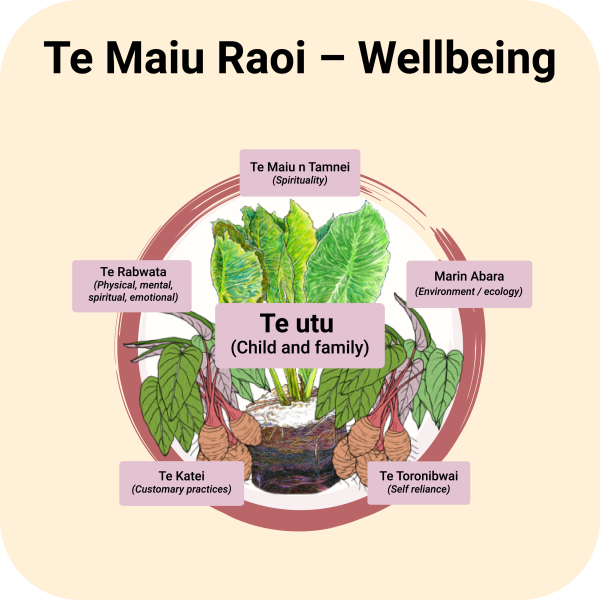
 Practice consideration – For I-Kiribati, the person is sacred and the body sacrosanct. In keeping with the sacredness of the body, it is forbidden to touch someone’s head (including that of a child), to walk over a person, or to physically walk in the middle of people having a conversation.
 Practice consideration – I-Kiribati will always help each other. The significance of relationships and strong kinship bonds ensures te utu and te kaainga (family and extended family) relationships can be drawn on for support. There will always be I-Kiribati te utu and community to draw on to support the te utu.
 The Ribanakin Te Ataei n Ana te Utu practice prompts:
Social structure
The Republic of Kiribati is a Micronesian archipelago of 33 islands (21 of which are inhabited), in the central and western Pacific, comprising the Gilbert Islands, the Line Islands and the Phoenix Islands. The Gilbert Islands are geographically and culturally divided into the Southern Gilbert, Central Gilbert and Northern Gilbert.
While they share a language, each Island group retains its own unique cultural traits and practices. One’s island of origin, abwamakoro, is an important part of I-Kiribati belonging, identity and connectedness.
In parallel to their ethnic communities, I-Kiribati congregate devoutly to their church groups, and to their islands and family groups.
Social structure definitions:
The subsistence and collective nature of Kiribati social structure is demonstrated by Ribanakin te bwabwai (the traditional practice of cultivating and growing te bwabwai), which is undertaken with involvement of the entire village with each member knowing and undertaking their different responsibility in the process. This process provides a metaphor for the way a child is raised in traditional Kiribati society. A healthy te bwabwai (root/crop) is the result of hard and time-consuming work, collectively undertaken, just as it is for a child. The wider community determines, when te bwabwai is shown in te mwaneaba (the traditional meeting hall), whether it’s a good or bad crop. The best interests of the community are served when a child is raised to become a valued and contributing member of its family and the community.
Kiribati society is strongly patriarchal, and this informs the clear status of ranking across the social stratus and within each household. The village household is the most important unit and within that unit is the unimwane (male elder), who is the head of the household, the power holder and decision-maker. Traditionally, the ascribed position of the unimwane is part of a community of elders who oversee the village. This position exists in traditional and contemporary settings either in an active or ceremonial role.
Te mwaneaba (the traditional meeting hall) is the social connection of village life in Kiribati. It is a place of tradition and ritual where village decisions are made by unimwane (village male elders), whose seating arrangements affirm their authority and status in the community.
Te mwaneaba ni Kiribati – The traditional meeting house of Kiribati: 'A tale of two islands', by Tony Whincup
Te mwaneaba is a central part of I-Kiribati culture and wellbeing, providing a space for individuals and families to meet to discuss the responsibilities of the community, a place to celebrate and for significant social activities, and a place of sanctuary for anyone to spend time during the day, eat a meal or to sleep for families without land or a house.
Dreams from Kiribati: Maintaining identity and social resilience post-migration, by Jerome Cameron (page 88)
In Kiribati custom, age is an important marker of status and respect. Elders are highly respected in Kiribati society, and this is a deeply ingrained cultural norm. Elders are respected for their knowledge of Kiribati culture and history – they are the traditional guardians of the culture.
Dreams from Kiribati: Maintaining identity and social resilience post-migration, by Jerome Cameron
They play many roles in the community, such as representing the family at meetings, organising meetings, and passing on cultural traditions to younger generations.
Te utu (family) will typically consist of parents, te karo (father), te tina (mother), ao tenan tibu (grandparents) and te atāei (child). Customary adoption is a common practice within extended family networks, reflecting the strong emphasis on kinship connection and responsibility, and the collective nature of Kiribati society.
The grandparents are highly respected elders. Known as te unimwane and te unaine, they represent the embodiment of Kiribati culture in the family. It is their responsibility to pass on traditional values, beliefs and skills to the next generations of their family.
It is important for each member of te utu (family) and te kaainga (extended family) to know what their roles and responsibilities are, to be attentive and obedient to both the male and female leaders of the family, and to have a helpful attitude. In traditional Kiribati society, parents, and in particular mothers, have the main responsibility for the care and upbringing of ataei (children), ensuring they are equipped with the skills and knowledge to do well in life. Grandparents are also involved in the care and development of their grandchildren. Older siblings are expected to be role models for younger brothers and sisters.
In I-Kiribati traditional society, ataei (children) are regarded as gifts from God to the family and are valued as a future source of support, particularly to ageing parents. As a valuable extension of te utu (family), it is important for ataei to be nurtured in the ways of te katei (the cultural practices distinct to I-Kiribati) and for the teaching to begin early.
The best interests of te ataei (the child) are seen by parents and te kaainga (extended family) as being met when they all fulfil their roles and duty to te ataei, ensuring they are being taught correctly.
Infants and ataei (children) under 4 years old are indulged and showered with attention and care by parents and te kaainga (extended family). However, as they become older, they begin to experience strict parental and family control, and expectations of behaviour change as ataei start learning to be obedient, respectful and helpful. By age 8 or 9, ataei are expected to start helping with household chores and other domestic responsibilities.
Older ataei are expected to help with household tasks, to show respect for elders and to refrain from calling attention to themselves when adults are present.
Children are not involved in family discussions and are expected to obey their parents and decisions made for them.
It is imperative to honour the dignity of the family, involving them and ensuring they can contribute to identifying the right people to be involved.
Roles and expectations in traditional Kiribati society are organised according to gender and age, reflecting a hierarchical structure and emphasising collectivism.
Te utu and te kaainga (family and extended family) function according to a set of rules and the fulfilment of roles and responsibilities assigned to its members. Relationships are important aspects of this. The closeness and bonding that occurs within te utu and te kaainga is a result of its members fulfilling their responsibilities to each other. There is also a sacred element attached to relationships, which creates an imperative to avoid dishonouring them.
Traditionally, labour is divided by gender, with men involved in activities that provide sustenance for the family, such as fishing and collecting toddy (the sap of coconut trees used to make traditional Kiribati drink), and being responsible for heavy construction tasks. Women are responsible for childcare and domestic chores. Although there is a collective responsibility, it is primarily the mother’s responsibility to look after ataei (children).
Grandmothers can also have a direct role in the care of ataei but the wider family’s collective responsibility for the ataei is more an oversight function, than primary care. This means there will always be someone available to watch ataei when the parents are not available.
The role of the brother is a respected and significant one in families. Male siblings have a responsibility to look after sisters, and sisters should respect their brothers regardless of age. Not only is the brother responsible for his sister but there is an expectation that a sister will go to her brother for support.
The brother–sister relationship is governed by rules based on te karinerine (respect) that keep it safe. There are, for example, certain expectations of siblings regarding appropriate physical boundaries. The relationship between brothers and sisters changes when they reach puberty, and there is more respect for the sister as she enters womanhood. The siblings are taught to maintain respectful distance from each other as they reach puberty. As an example, an adult brother and sister would not go out together in the evening unchaperoned.
Relationships, which underpin the functioning of te utu and te kaainga (family and extended family), have a sacred element. Relational disharmony is a violation of that sacredness. Violating or dishonouring relationships invites bad luck or other unwanted consequences, including the judgement of the community.