

Bhavish – Fiji Indian cultural approach
Bhavish is an ethnic-specific cultural approach for Va'aifetū that offers all practitioners essential cultural and practice knowledge, skills and behaviours for working with Fiji Indian children, young people, families, caregivers and communities.Bhavish
'The future depends on what we do in the present.' Mahatma Gandhi
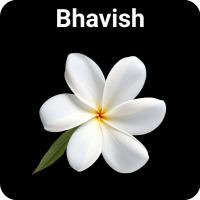 Bhavish means 'future' in the Hindi language.
The Hindi word खुशबू (Khushbu) refers to a fragrant and pleasing odour associated with feelings of happiness, comfort and wellbeing. It is a word that evokes sensory experiences and emotions of nostalgia, triggering happy recollections of people, places and experiences. The word Khushbu is used in this context to describe the fragrance of the frangipani flower, which is ubiquitous in Fiji and plays a significant role in religious ceremonies, festivals and daily life.
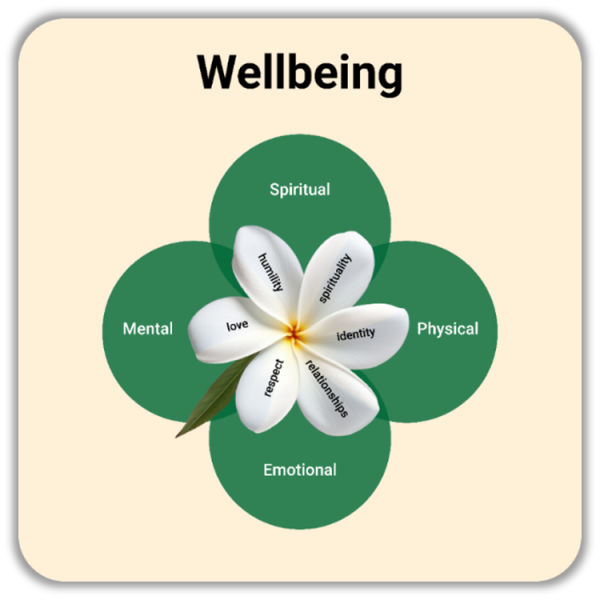
The frangipani flower was chosen by our Fiji Indian cultural advisors as the visual representation of Bhavish due to its Khushbu, with its powerful scent evoking memories and emotions relating to 'days with families and friends and community, filled with laughter, food, celebrations, sunshine, clear waters, sugarcane fields, the rivers, the mountains, villages and homes where frangipani trees were part of the landscape'. Its association with religious and traditional practices and daily life makes the frangipani flower a symbol of cultural identity, spiritual connection and the beauty of their home in Fiji. In this respect, it becomes a visual representation of wellbeing.
Worldview
A Fiji Indian worldview is a construct of values, beliefs and practices that uphold wellbeing and the Fiji Indian way of life based on migration history, cultural identity and spirituality.
Fiji Indian people migrated from India to Fiji in the late 1800s as indentured labourers. Many did not return to their homelands in India and made Fiji their permanent home. Over time, displacement and the long separation from India caused a different cultural identity to develop, retaining and losing some aspects of their indigenous culture and shaped by experiences of adversity and a dedication to hard work.
The maintenance of spiritual beliefs is an enduring aspect of Fiji Indian people’s identity, informing what is important in life and guiding their purpose in life through honourable conduct, which includes honesty, obedience and being true to oneself. Spirituality is expressed through several faiths, including Hindu, Muslim, Sikh and Christian, the orientation of each being deeply embedded into the fabric of daily life.
 Practice consideration – A shared worldview for Fiji Indian peoples is anchored to their migration history, cultural identity and spirituality. However, we need to recognise and respect the diversity of Fiji Indian parivāar (family, families) whose traditions, values and beliefs are not homogeneous but based on their lived experience and spiritual orientation.
Historical experiences of adversity have shaped identity connected to the value of working hard for economic success, educational achievement and employment, and social and political agency.
'In Fiji, indentured labourers had to eat, work, and live together, and these kinds of things demolished the caste system among Indians. They kept alive their Indian culture and tradition by reciting religious songs on festivals, and they celebrated all festivals with each other, forgetting about the caste differences and religious differences. Despite the hardships they had to face on the plantation, Indians fought for their identity and equal rights and [had] success in getting an identity as Indo-Fijian. The journey of Indian indentured labourers turned the dark side of the diaspora into the positive side by their hard-work, struggle [and] sacrifices, and [they became] citizens of Fiji island and known as Indo-Fijian.'
Kadri Nashrin, The Journey of Indian Diaspora as Indian Indentured Labourers in Fiji (2023)
Spirituality is fundamental to Fiji Indian life and ways of being, and connected to wellbeing. Fiji Indians express their spirituality through religion, with the majority being practising Hindus, Muslims, Sikhs or Christians. Religious orientation is strongly connected with identity, and caregivers and parents impress on their bachō (children) from an early age to uphold their religious faith and traditions. The strength of their religious conviction is demonstrated by Fiji Indians' strong preference to marry within their religion – when this isn't possible, it is not unusual for there to be an expectation that the bride will convert to her husband's religion.
The spiritual beliefs of Fiji Indians permeate all aspects of their lives, including time of worship, choice of partner, gender roles, friendships, dress, as well as more routine aspects of daily life such as food consumption and preparation, personal grooming and hygiene practices.
 Practice consideration – Religious practices and beliefs inform appropriate conduct pertaining to gender. Muslim women wearing a burka (veil) will not unveil themselves in front of a male. Although Muslim women wearing a burka from other parts of the world would be unlikely to engage with a male professional such as a social worker, Fiji Indian Muslim women wearing a burka might choose to. However, wherever possible, female professionals (social workers) should engage with Muslim women. Similarly, while female professionals may not have difficulty engaging with a Muslim man, the presence of a male professional would help engagement.
We need to understand the religious characteristics and practices of parivāar (family, families), along with associated expectations of their bachō (children). This includes the significance of spiritual beliefs attached to daily practices that Fiji Indian bachō are expected to uphold.
Practice consideration – The religious diversity of Fiji Indians requires our exploration, rather than assumption, of this crucial dimension of their wellbeing. We do not assume that what we have understood about one parivāar (family) can be generalised across others. Explore with bachō (children, young people) and parivāar their religious affiliations to understand what's important to them and why. This includes significant rituals and practices, which might be daily, occasional, communal or individual.
The essence of spirituality for Fiji Indian people is reverence to God, compelling them to honour bachō as a gift from God in recognition that gifts from God are to be revered and honoured.
Wellbeing
Four key dimensions of wellbeing for Fiji Indian people are deeply intertwined with their cultural values, traditions and social structures. Spiritual wellbeing, physical wellbeing, emotional wellbeing and mental wellbeing are interconnected and mutually reinforcing dimensions that must be in balance for overall wellbeing for individual and collective.
Kaimahi talk about wellbeing
Application of wellbeing to practice
Bhavish is defined as 'future' in the Hindi language, or what is yet to come. It encompasses events, experiences and possibilities not yet realised but incorporating hope and expectation, the potential for positive outcomes and the anticipation of a brighter future. In relation to the Fiji Indian cultural approach, the optimistic outlook characterised by Bhavish provides a source of strength and motivation for bachō (children) and parivāar (family) we work with. The emphasis on positive future outcomes highlights the strength and resilience of parivāar, promotes wellbeing and empowers them to achieve their aspirations.
Respect is a fundamental value expressed through behaviours that demonstrate deference, consideration and esteem for others, especially elders, authority figures and tradition. This value is demonstrated through language – the use of honorific titles and greetings, body language, dress and conduct and following traditional norms and expectations such as those that govern behaviour and relationships.
Application to practice
- Be respectful of parivāar (family) hierarchy and structure, and engage accordingly. For example, elders hold positions of authority and respect and should be included in discussions and decision-making, utilising their influence and wisdom.
- Be cognisant of the expectation on bachō (children and young people) to respect their parents and elders, and to follow their guidance and advice.
- Be attuned to and validating of the deep-seated importance of parivāar honour within parivāar, addressing concerns about potential harm to family honour with sensitivity and respect. Work with parivāar to find solutions that respect both traditional values and the needs of individual parivāar members, especially bachō.
- Explore honorific titles for elders as a sign of your respect for them. (Elders are addressed with honorific titles such as bhai (brother), bhabhi (sister-in-law), chacha (uncle) or chachi (aunt).)
- Be aware that the way you dress and your conduct, speech and language are being interpreted. Ensure you dress, act and speak in ways that show respect towards members of the parivāar.
- Fiji Indians use respectful language when interacting with each other and try to avoid conflict. Be sure to do the same – be polite, avoid a confrontational tone and demonstrate respect for their feelings and perspectives.
- Take time to listen to the parivāar narratives and their aspirations for their bachō.
Practice consideration – 'Ji' is a gender-neutral term of respect for people and relationships. Adding 'ji' to the end of someone’s name is a demonstration of respect. When addressing elderly members of the family or family priests, for example, adding 'ji' demonstrates your respect for them and their status, thereby upholding the sacredness of that relationship. 'Ji' is used to denote respect in any relationship – for example, mata-ji (respected mother), baba-ji (respected father), uncle-ji, behen-ji (respected sister), bevi-ji (respected madam), bhabhi-ji (respected sister-in-law), guru-ji (respected master), pandit-ji (scholar sir). (In another context such as a general conversation, 'ji-nahi is a respectful way of saying 'no'. The addition of ‘ji’ denotes respect.)
Bhavish practice prompts
 The Bhavish practice prompts:
- cover important principles and values
- explain what our practice should include for each one
- provide a set of reflective questions.
Useful words and phrases
Sources for the Fiji Indian cultural approach
Va'aifetū principles, cultural frameworks and guidelines: Fiji-Indians in the Pacific (DOCX 6.2 MB) (pages 21 to 26)
Kadri Nashrin's The Journey of Indian Diaspora as Indian Indentured Labourers in Fiji (2023)
Kiran Jha's Beyond the Seamless Web: The Decline of Caste in Fiji (2021) (pages 78 to 81)
Can't find what you're looking for? Try the search bar or view policies.
Social structure
The social structure of Fiji Indian people is complex and deeply rooted in both their Indian heritage and their experiences in Fiji. An understanding of the social structure is an important part of understanding the behaviour and cultural ways of being of the bachō (children) and parivāar (family) we are working with.
In Fiji Indian society, the traditional caste system of India has undergone changes and adaptations over time as many Fiji Indians have moved away from traditional caste practices towards a more egalitarian society. Their experience of indentured labour significantly undermined the maintenance of a caste hierarchy when labourers were forced to work and live together in arduous conditions regardless of caste, and the practice of assuming, or counterfeit claims to, higher caste names during this time of migration made authentication of status difficult. Nevertheless, while the rigidity of caste distinctions may have diminished over time, its relevance persists in various forms in Fiji Indian society, including through class distinctions based on wealth and economic status.
Features of the traditional system maintain a continuing influence in social interactions and marriage choices. Many Fiji Indians still prefer their adult bachō (children) to marry someone of the same caste, but additional key considerations are social standing, occupation, wealth and education of the spouse. Wealth and occupation are overriding factors in many marriage alliances.
Class distinctions within the Fiji Indian community, arising from key cultural and socio-economic influences, can result in varying levels of access to resources and opportunities. Those at the lower end of the class continuum, usually unskilled and lacking formal education, can have less access to resources and opportunity for upward mobility.
Parivāar (family) is a fundamental concept for Fiji Indians that encompasses not just the nuclear family but includes extended family members as a collective in which everyone understands their role and responsibilities. It is a structure of family that supports the wellbeing of Fiji Indians' parivāar through collective support, preservation of culture and traditions, opportunities to enhance economic stability and encouraging social unity.
The extended family includes grandparents, uncles, aunts and cousins, and is central to the interconnectedness of familial relationships and the support that family members provide to each other. The structure of parivāar emphasises strong intergeneration ties where elders play a significant role in the development of younger generations by imparting wisdom, cultural values and traditions to them. Multiple generations frequently live together or in proximity, with grandparents often involved in childcare and passing down cultural teachings that reinforce the family's heritage and values. Respect for elders is deeply ingrained in Fiji Indian culture, with bachō expected to show deference to their grandparents and older relatives.
Parivāar instils a sense of responsibility and duty among its members and an expectation that individuals contribute to the wellbeing of the family and community. This extends to economic cooperation among family members, which can lead to financial stability and success. Joint family systems are common where brothers and their parivāar live together, sharing resources and responsibilities.
It is not unusual for adult bachō to remain living with their parents until marriage and perhaps beyond, and respect for elders is exemplified through the practice of adult bachō caring for ageing parents.
Parivāar is deeply linked to the broader community in which cultural practices, traditions and values, essential to the identity of Fiji Indian parivāar, are preserved and transmitted through communal activities, including celebrations, festivals and religious gatherings. Community is the space where parivāar come together to perform rituals, share food, provide support in times of adversity, worship, strengthen their social networks and pass down their traditions to younger generations.
Traditionally, the family structure is patriarchal, with the eldest male (father or grandfather) holding authority and decision-making power. With this authority, the head of the family is responsible for the welfare of the family and their decisions carry significant weight. However, while still maintaining their cultural heritage and traditions, women's roles in Fiji Indian parivāar are gradually adapting to changing social and economic contexts. In Aotearoa New Zealand, this evolution can mean that a husband's status as head of the household does not preclude him from consulting with his wife before making important decisions.
Sons and daughters
In Fiji Indian parivāar (family), the position of eldest son comes with expectations of leadership and responsibility. Eldest sons are often regarded as the primary caregiver and decision-maker after the parents. They may be responsible for making important parivāar decisions, managing finances and taking care of ageing parents. Eldest sons may lead parivāar rituals during festivals or ceremonies.
Sons, in general, are bearers of the parivāar name and lineage. They are expected to contribute to the parivāar economic wellbeing and uphold its honour.
Daughters are traditionally seen as caregivers within the parivāar, contributing to household duties and supporting with the care of younger siblings. However, education is highly valued in Fiji Indian parivāar, and daughters are increasingly encouraged to pursue academic and professional opportunities.
Brothers and sisters
The relationship between brothers and sisters is sacred, characterised by mutual support, love and protection. A brother has a responsibility to protect his sister, while a sister will nurture and emotionally support her brother. The protective instinct is deeply ingrained in cultural values where a brother’s honour is often tied to the wellbeing of his sister. Protecting a sister can extend from protecting her from harm to monitoring her social interactions and behaviours and to protecting her from inappropriate relationships and choosing her husband.
Raksha bandhan, also known as raakhi, is the celebration of the bond between brothers and sisters. The central ritual involves the sister tying a sacred thread, a raakhi, around her brother's wrist, symbolising her prayers for her brother's wellbeing and protection. In return, the brother pledges lifelong protection and support for his sister.
Grandparents
Grandparents hold a significant and revered position within Fiji Indian parivāar (family); passing down and reinforcing the importance of cultural values, traditions and spiritual beliefs; providing emotional and practical support for their bachō (children) and grandchildren, usually closely involved in caring for their grandchildren; and as respected authority figures in the parivāar. The relationship between the grandparents and the grandchildren is strong.
Place of bachō (children and young people)
The relationship between mother and bachō (child) begins from conception. This belief is fundamental to Fiji Indian culture and emphasises the spiritual connection between the mother and bachō, a sacred bond with the mother viewed as a vessel for divine creation.
Bachō are treasured and guarded, guided and protected by their parivāar (family) and God. Parivāar is central and key – all members, immediate and extended, have duties and responsibilities to the collective good, which includes aspirations for bachō. Bachō are considered critical for the future of the parivāar, being the connecting link between the generations, essential to carrying the parivāar name, religion, norms, beliefs culture and traditions or rituals into the future.
The concept of filial duty, the responsibilities and obligations of bachō towards parents and parivāar members, is deeply ingrained in Fiji Indian culture. Bachō are raised with high expectations to succeed and contribute to the honour of parivāar. Values that take away from this traditional path are resisted. Fiji Indian parivāar look negatively on bachō rights to express views and have more social freedom.
Bachō are taught to view their role in their parivāar in terms of relationships, obligation and responsibilities. Bachō are quite likely to live with parents as adults until married or even after. There is also a strong sense of responsibility towards extended family.
The concept of rishta signifies relationships and connections, especially within the context of parivāar and community. This concept emphasises cultural principles that are foundational to relationships for Fiji Indian people, guiding interactions and shaping family dynamics. These include respect, interconnectedness, support and care, loyalty, and cultural continuity, principles that uphold the centrality of parivāar and distinct significance of family roles and positions such as elders, parents (mother and father), eldest son, brother and sister.
For example, the proverb 'Heaven lies beneath a mother's feet and the father opens the door' expresses the concept of rishta and the principles it embodies. 'Heaven lies beneath a mother's feet' emphasises the significance of a mother's love, care and sacrifice for the upbringing of her bachō (children), comparing this to the closest thing to heaven on earth. 'The father opens the door' signifies the father's role as protector and provider, creating opportunities for his bachō to do well in life. Despite the traditionally patriarchal structure of Fiji Indian parivāar, this proverb conveys the complementary roles of both parents. It acknowledges that both parents are essential for the nurturing and wellbeing of their bachō and must be respected in equal measure. While a father is the traditional decision-maker, the mother may often be a behind the scenes influence.
Family honour
Family honour is a significant cultural value in Fiji Indian society and an important concept to understand from a practice perspective because it influences relationships, social interactions and individual behaviours. Understanding family honour provides insights into the cultural dynamics of Fiji Indian parivāar (family). Family honour upholds the actions and behaviours of individual family members as a reflection on the entire parivāar. This concept encompasses a range of factors, including moral conduct, adherence to cultural traditions, and the behaviour of family members especially relating to gender roles. The reputation of the parivāar is tied to how its members conduct themselves in public and in private. Academic and professional achievement, material success and exemplary social behaviour are highly valued for enhancing family honour.
Filial duty (see above) is connected to family honour. Bachō are expected to behave in ways that reflect positively on their parivāar – for example, they are expected to show deference to their elders. They are encouraged to do well in their studies and careers, bringing pride and honour to their family name, reinforcing their parents' investment in their success. This can be an area of contention for bachō when, for example, their traditional norms clash with the more permissive cultures of their non-Fiji Indian peers. Bachō may challenge traditional norms, leading to conflict with parents and elders who hold firmly to these values, or acting outside parivāar expectations might lead them to experience feelings of guilt and shame.
Family honour plays a critical part in shaping relationships not only in the parivāar but also the community. Parivāar are often judged on their adherence to cultural norms and the behaviours of its members, influencing social interactions and relationships with neighbours and friends.