

Ko e Niu e – Niue cultural approach
Ko e Niu e is an ethnic-specific cultural approach for Va'aifetū that offers all practitioners essential cultural and practice knowledge, skills and behaviours for working with Niue children, young people, families, caregivers and communities.Ko e Niu e
Tuku atu e tau nava mo e tau fakaheke ke he Atua he lagi likoliko ha ko e haana tau Monuina oti kua fakatapulu aki a tautolu oti ko e tau tagata Niue.
We give honour and respect to our Lord God in the mighty heavens for his great love and care to all the Niue people.
Ko e Niu e is represented by the metaphor of a niu (coconut), which is significant in the context of working with Niue fanau / tau fanau (children) and magafaoa (family), caregivers and communities in child protection, youth justice, adoptions and all other areas of our practice.
Worldview – aga faka Niue
Ko e tau fanau ko e tau koloa uho.
Children are our treasures.
A Niue worldview is expressed through the term ‘aga faka Niue’, which means a ‘Niue way of being’.
Aga faka Niue is based on a value system that supports a collective approach to life. It reinforces the significance of Niue values, beliefs, language and connection to land, for fanau / tau fanau (children), magafaoa (family) and maaga (village, community/group) as holistically integrated into a way of life. In the Niue world, tama (child) or fanau / tau fanau are seen and valued as treasures by magafaoa and maaga. For practitioners, understanding the constructs of aga faka Niue holds significant importance for Niue fanau / tau fanau, especially for those living outside of Niue. This plays a critical role in shaping their identity, cultural connection and supporting their wellbeing.
Aga faka Niue comprises the following:
Roles and responsibilities within the structure
Wellbeing – Moui katoatoa
For Niue people, wellbeing can be described as having a happy life that is safe, in good circumstances and full of blessings. Wellbeing for fanau / tau fanau (children) is linked to their magafaoa (family), maaga (village, community/group) and cultural identity. Moui katoatoa means the holistic wellbeing of fanau / tau fanau, magafaoa and maaga. It encompasses everything around the fanau / tau fanau and sitting at the core of moui katoatoa is moui olaola (rich and thriving life of good circumstances and blessings). To achieve a state of moui olaola are the 4 dimensions of wellbeing. These need to be balanced to radiate wellness to the fanau / tau fanau, magafaoa and maaga. This can also be known as moui monuina where the fanau / tau fanau and family are growing, loved, protected and safe. Ko e Niu e dimensions of wellbeing contribute to a holistic understanding of wellbeing for fanau / tau fanau (children) and magafaoa (family). As illustrated below, the hard outer shell and soft interior of the niu (coconut) symbolises the need to look beyond surface appearances and behaviours to understand the deeper needs and circumstances of fanau / tau fanau and magafaoa.
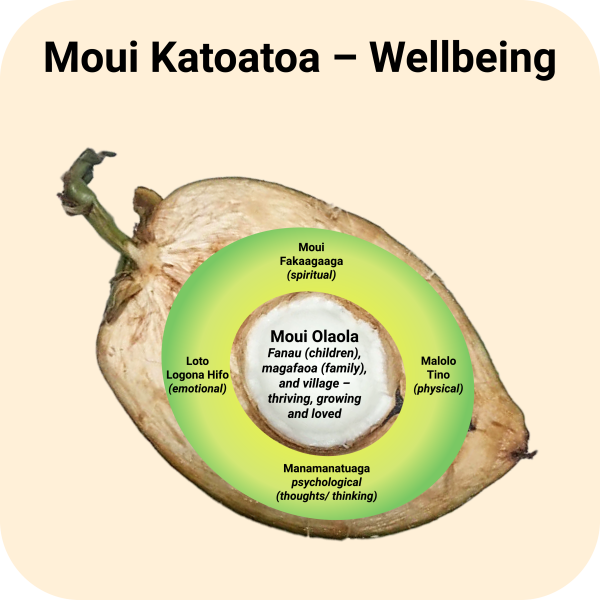
When there is an imbalance in 1 of the 4 dimensions in moui katoatoa (holistic wellbeing), then there is disharmony, and wellness is compromised. This will have a direct effect on the moui olaola (rich and thriving life of good circumstances and blessings) of everyone. One of the roles and responsibilities of the ulu he magafaoa (leader of the family) is to lead the magafaoa and to bring the village around the fanau / tau fanau to work together to bring balance, peace and restoration.
The 4 dimensions of moui katoatoa are:
Kaimahi talk about wellbeing
Exploring the dimensions
Exploring the dimensions offers an understanding of what impacts wellbeing and what needs strengthening to restore wellbeing so fanau / tau fanau (children) and magafaoa (family) are safe and flourishing.
Values and their application to practice
Ko e Niu e values – fakalilifu (respect), fakafetuiaga (relationships), loto fakatokolalo (humility), moui fakaagaaga (spirituality), tau matutakiaga fakamagafaoa (connections), fakafeofanaki (communal care) – are integral to practising social work with Niue fanau / tau fanau (children) and magafaoa (family).
Understanding these values and functions in practice ensures that fanau / tau fanau perspectives are considered and acknowledged in any decisions or actions taken. Applying the values enables the practitioner to have trusting and meaningful relationships with fanau / tau fanau (children), magafaoa (family) and maaga (village) and community. The values allow us to work with fanau / tau fanau and magafaoa in ways that are meaningful for them because application of the values reflect their worldview and ways of knowing. If we at times hold different views from fanau / tau fanau and magafaoa, upholding the values allows us to engage around these different views from a respectful and better-informed position. Applying the values ensures our practice is relational, inclusive and restorative.
Ko e Niu e practice prompts
 The Ko e Niu e practice prompts:
- cover important principles and values
- explain what our practice should include for each one
- provide a set of reflective questions.
Useful words and phrases
Sources for Niue approach
Ko e Niu-e Chant composed by Ben Tanaki.
Matenga Ikihele, AM (2023) Kia tupuolaola e moui he Tagata Niue: Navigating health, wellbeing and digital spaces | University of Auckland Research Space
Can't find what you're looking for? Try the search bar or view policies.
Social structure
Diagram: Niue social structure.
The social structure of Niue society is characterised by its strong emphasis on family and community. This traditional social structure encounters modern challenges, including issues of cultural identity, balancing the tension that sometimes exists between traditional and contemporary values and the necessity of adapting to the new and evolving environment outside of Niue.
Nevertheless, the Niue social structure is crucial for understanding the influence on fanau / tau fanau (children) of the social environment they are raised in, in which collective responsibility is a central tenant that contributes to their protection, nurture and wellbeing.
From a Niue perspective, every tama (child) belongs to a magafaoa (family). The social structure highlights how fanau / tau fanau (children) lie at the heart of their community. However, some magafaoa may experience challenges and strains on existing relationships within the structure. Of note, within the Niue culture, there are no allowances for harm, abuse or exploitation of fanau / tau fanau. They are protected and supported in all aspects of their lives to ensure their safety, wellbeing and development. Understanding roles and responsibilities and their connection to the fanau / tau fanau and magafaoa helps the social worker or practitioner to recognise who holds influence and authority within the magafaoa and community. This helps to enhance safety planning processes, ensuring protective measures are culturally appropriate and effective.
The nuclear family is core where the fanau / tau fanau (children) in the unit are supported by their parents or caregivers.
The father is traditionally the head of the family unit, although not all families are the same.
In more contemporary nuclear families, there will be a blend of traditional and modern domestic arrangements.
The extended family plays multiple and critical roles that contribute to the wellbeing of the individual and wider collective family.
They act as support and security for each other.
This network of support provided by the extended family ensures that individuals are not in isolation, and they can depend on each other for support.
The family’s community, church in particular, their religious communities and village affiliations are important.
The role of the church and village helps to maintain customs and traditions.
Of note, outside of Niue, new associations to sports groups and other groups are becoming increasingly important social contexts for tagata Niue (Niue people) communities to retain cultural significance.
Kia tupuolaola e moui he Tagata Niue: Navigating health, wellbeing and digital spaces | University of Auckland Research Space
Represents one’s unique cultural identity as tagata Niue (Niue people). Ko e tagata Niue is encompassing of the nuclear, extended family, church and village.