

Tautua – Samoan cultural approach
Tautua is an ethnic-specific cultural approach for Va'aifetū that offers all practitioners essential cultural and practice knowledge, skills and behaviours for working with Samoan children, young people, families, caregivers and communities.Tautua
O le ala i le pule o le tautua – the path to leadership is through service
Tautua as a name for the Samoan cultural approach was endorsed by key Samoan practitioners, past and present, and community members inspired by this Samoan proverb.
Tautua offers practitioners essential and fundamental cultural knowledge, skills and behaviours for working with Samoan fanau/tamaiti (children/young people), āiga (family), caregivers and communities across child protection, youth justice, adoptions and other areas of our practice. It also:
- reflects the Oranga Tamariki practice approach, integrating Samoan cultural knowledge and practice and drawing on a Samoan perspective of soifua manuia (wellbeing)
- provides the opportunity to acknowledge, explore and understand what is important in the lives of, and wellbeing for, Samoan fanau/tamaiti and āiga in Aotearoa New Zealand
- serves the best interests of Samoan fanau/tamaiti and āiga that we provide a social work service for.
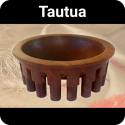
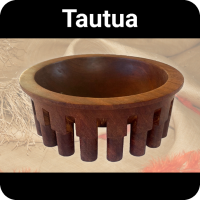 The visual representation of the Tautua cultural approach draws on the tanoa as a metaphor for collective unity and ownership of and responsibility for the soifua manuia (wellbeing), safety, prosperity and dignity of fanau/tamaiti (children/young people) and āiga (family).
The tanoa is a ceremonial bowl used to prepare the traditional ceremonial drink 'ava for formal gatherings of matai of āiga, āiga lautele and nu'u. The gathering of matai occurs when there are matters of importance to be discussed that affect the interests of the āiga lautele or the nu'u or community.
Worldview
Fa’aSamoa is referenced as the Samoan worldview, which is the total make-up of the Samoan culture that encompasses the invisible and visible that form the basis of principles, values and beliefs of Samoans.
A Samoan worldview provides an aspiration for a fulfilling life, with tofā mamao (greater vision) and a finer spirit of hope and achievement. The Samoan worldview is informed by tū ma aga fa’aSamoa, the way of life and umbilical cord that attaches Samoans to their culture. Tū ma aga fa’aSamoa provides a lens for social workers to understand and contexualise key behaviours, motivation, issues and decisions that occur in the life of fanau/tamaiti (children/young people) and their āiga (family).
The pulse of tū ma aga fa’aSamoa signals behaviours and expectations essential to maintaining balance and harmony in all aspects of Samoan life. Tū ma aga fa’aSamoa consists of:
The value of children in the Samoan worldview
O tamaiti, e taulia tele i le aganuu, auā o le lumanai manuia lea o se aiga. Samoans value children, as they are the future of a family.
This well-known Samoan proverb highlights the value of children in the Samoan culture. They are seen as a tofi (an inheritance and gift from God). Samoan children are considered as future leaders of the community and integral to the continuity and preservation of the āiga (family). Ultimately, children hold a special place in Samoan culture, symbolising hope, unity and the continuation of the Samoan way of life.
In a Samoan worldview, children are taught to respect their elders, to be humble, and to prioritise family and community wellbeing. They are nurtured with love and guidance to grow into responsible and respectful individuals who contribute positively to the community. Of significance, because children are seen as the foundation of Samoan society, they are cared for and supported by the entire community, not just their immediate family.
Wellbeing – Soifua manuia
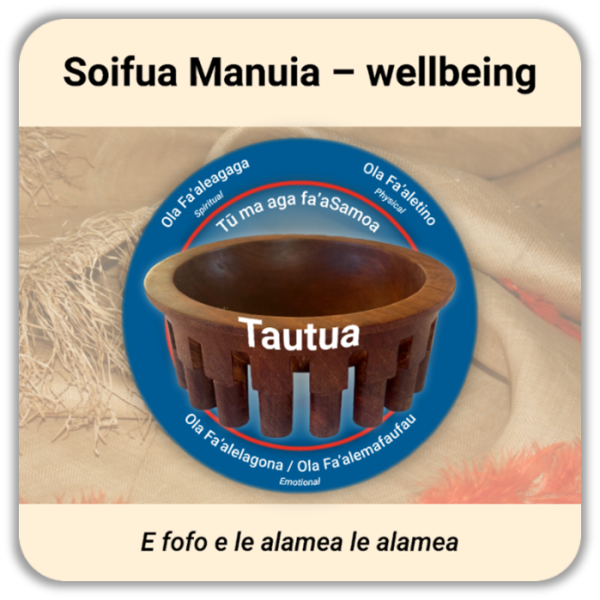
Soifua manuia is the term that embodies a Samoan perspective of wellbeing. Soifua manuia is a collective state within which the soifua manuia of the individual and the collective (such as āiga, āiga lautele) are inextricably connected.
Tū ma aga fa’aSamoa (the Samoan way of life) is at the heart of soifua manuia, and the achievement and maintenance of soifua manuia requires a balance of ola fa’aleagaga (spiritual), ola fa’aletino (physical) and ola fa’alelagona / ola fa’alemafaufau (emotional) wellbeing for the individual and collective.
E so’o le fau i le fau – unity is strength
A well-known Samoan proverb ‘E fofō e le alamea le alamea’ refers to a tropical fish (alamea) that carries the antidote to its own poison in its body. The poison is released from the skin (healing itself). When a person is harmed by the ‘alamea’, another ‘alamea’ is required to draw out the poison. This proverb reflects the Samoan belief in the strength, capacity and collaboration of āiga (family) to find their own solutions to challenges, and the restoration of their soifua manuia.
Kaimahi talk about wellbeing
Application to practice
Tautua (service) is a key life value and fundamental tenet of being Samoan.
The premise of tautua is based on service – service to one’s āiga (family), nu’u (village), God and country. Tautua is a value by which Samoan families continually seek to improve their life situation through the observation of and adherence to roles and responsibilities. It is a value that upholds the soifua manuia (wellbeing) of the collective – to serve others and not to be served, embodied in shared responsibilities to meet need wherever need exists so that fanau/tamaiti (children/young people) are nurtured and taught, the matua (elderly) are cared for, the āiga is supported.
O le tagata ma ona fa’asinomaga. Each person is appointed their duties and responsibilities.
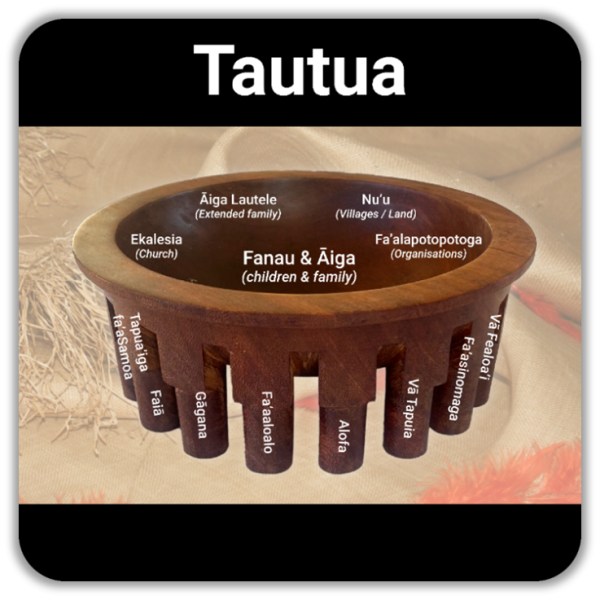
At the centre of the tanoa are the fanau/tamaiti (children/young people) and āiga (family). Surrounding them as part of their eco system is the ekalesia (church), āiga lautele (extended family), nu’u (village) and fa’alapotopotoga (organisations, communities) of significance. The legs of the tanoa represent the aga tausili (key values of fa’aSamoa), which are embedded in the social structure of āiga (family). These values are interconnected (that is, expressed simultaneously across contexts and situations). Aga tausili give effect to tautua (service) by informing the actions, behaviours and attitudes that uphold the obligations for service to others. In this respect, aga tausili contributes to the soifua manuia (wellbeing) of fanau/tamaiti and āiga.
Aga tausili provide signposts for identifying and responding to harm occurring for fanau/tamaiti and āiga, and seeking and forming restorative solutions, always remembering ‘E fofō e le alamea le alamea’ – that through the strengths, capacity and collaboration of āiga, they can find their own solutions to challenges, and the restoration of their soifua manuia (wellbeing).
Tautua concepts
O le ala i le pule o le tautua. The pathway to leadership is through service.
Within the realm of tautua are numerous expressions of service, demonstrated across different contexts and reflecting expectations of roles and associated responsibilities:
- Tautua matavela – service with full commitment and honesty, going over and above the call of duty.
- Tautua matalilo – service done behind the scenes (service and leadership is not always at the front or leading the way).
- Tautua toto – service with sacrifice, caring of ageing parents, grandparents, unwell or disabled fanau/tamaiti or members of āiga.
- Tautua aitaumalele – service from a distance (such as āiga who live overseas supporting the ones back home).
- Tautua nofotuavae – to sit behind or at the feet of someone (matai, elder, leader). Exemplifies the person who stands behind their matai (chief), leader or agency ready to serve.
Tautua matavela can be considered as an overarching demonstration of service because service with full commitment and honesty is the foundation for tautua matalilo, tautua toto, tautua aitaumalele and tautua nofotuavae.
 Practice consideration – Obligations attached to tautua aitaumalele (service from a distance) can create hardship for āiga living in Aotearoa New Zealand supporting āiga lautele and nu’u back home, and the ekalesia, through remittances and care packages. However, the belief that “O le tagata e le’i tautua e lē malamalama i totonu o lona ‘āiga ae sili ona pogisa i tulaga o le nu’u” (a person who has not served will not be recognised inside their family but will be plunged into even further darkness with regards to their village) serves as a strong motivator for meeting their obligations regardless of the sacrifice this entails.
Tautua practice prompts
 The Tautua practice prompts:
- cover important principles and values
- explain what our practice should include for each one
- provide a set of reflective questions.
Useful words and phrases
Can't find what you're looking for? Try the search bar or view policies.
Social structure
In Aotearoa New Zealand, acculturation influences give rise to contemporary āiga (families) who can be located across a broad continuum of Samoan cultural identity, practices and worldview. An understanding of the traditional structure of Samoan society, including the roles, functions and responsibilities central to āiga, is necessary for understanding where āiga sit on that continuum.
Traditionally, the unit of Samoan society is the āiga (family) and not the individual. This is based on a collectivist system known as fa’amatai and the place of fanau/tamaiti is clearly set. The fa’amatai system is to ensure that the āiga is well cared for now and in the future. Society is organised by the āiga lautele (extended families) with each āiga having its own matai (chief or leader) titles that denotes the nu’u (village) a person is connected to, their place of origin and other names associated with their āiga. There is an expectation that all members of the āiga contribute to this system.
Through their eyes: A Samoan perspective on child wellbeing, by Emma Dunlop-Bennett
The fa’amatai system comprises 5 groups, reinforcing the importance of unity and collaboration of the whole. This system is applicable in the āiga (family) and nu’u (village):
Everyone’s place is referenced in the fa’amatai system, every Samoan can establish a relationship to their āiga and nu’u through their fa’asinomaga (identity). For social workers, understanding the āiga structure, roles and responsibilities from a Samoan worldview will enable you to better understand the traditional āiga structure and expectations, roles and responsibilities of each member of the āiga.
Of significance is the role of the faife’au (pastoral leaders). With the arrival of Europeans to Samoa in the 1830s, Christianity and the significance of faife’au was weaved within fa’aSamoa. Faife’au are held in high regard and status within fa’aSamoa – they are given the same honour and respect as matai. There are āiga who do not have a matai within their social structure – they may have strong connections within their ekalesia (church) and may see the faife’au as their pillar of leadership, support, guidance and advice.
The Samoan social structure identifies the prominent place of fanau/tamaiti (children/young people), their roles and responsibilities to support the collective. The collective role is to teach, develop, nurture and protect fanau/tamaiti and their soifua manuia (wellbeing) as they grow. This social structure enables and prepares fanau/tamaiti to be the best representation of God, their āiga (family) and nu’u (village) and nation. The following roles and responsibilities of āiga support the collective decisions that is central to the best interests of fanau/tamaiti.
Āiga (family)
The family has a collective responsibility for raising fanau/tamaiti (children/young people), supporting the mother who has the primary role in nurturing and caring for pēpē (baby/babies) and fanau/tamaiti. Older siblings will look after younger siblings, matua o matua (grandparents) may have a role in the care of their fanau o fanau (grandchildren). The collective support is to teach the values, knowledge, culture and narratives that have been handed down generation to generation. Each member of āiga supports the collective, enacting their specific roles and responsibilities to provide safety, security and protection of the collective soifua manuia (wellbeing) of fanau/tamaiti and āiga.
Decision-making
Matua (parents, aunts, and uncles) within the āiga (family) may hold cultural leadership roles, matai (chief) titles or pastoral roles. The roles, responsibilities and expectations of each member of the āiga is dependent on titles, status, age, gender. Matua will gather to discuss matters that require decisions to be made. A collective approach ensures all voices are heard to strengthen decision-making. Matua will consider the best interests of their fanau/tamaiti (children/young people) to ensure that they continue to be nurtured, safe, protected and thrive to do well in life.
While every household has a lead person or people, they are not always a matai. A matai does not hold sole authority in Samoan āiga – they must consult widely before representing the āiga interests. In Samoa and Aotearoa New Zealand, many āiga are headed by women who may or may not carry matai titles and responsibilities but are nevertheless leaders and decision-makers. Women’s role in leadership is something Samoans have in common with matrilineal communities in other parts of the Pacific.
Feagaiga (sacred brother–sister covenant)
The sacred relationship between a brother and sister is expressed in the Samoan proverb “O le i’o i mata o le tama o le teine” (the pupil of the brother’s eye is his sister). The brother’s role is to keep his sister protected, safe and cater for her every wish. Upholding the feagaiga is central to the continued safety and soifua manuia (wellbeing) of all parties within the feagaiga.
The nature and structure of āiga in Aotearoa New Zealand is ever evolving. The extent to which tū ma aga fa’aSamoa (the Samoan way of life) is practised by aiga in contemporary settings will vary according to the histories and lived experiences of its members. This includes the diversity of mixed ethnicities. Across the trajectory of Samoan traditional and contemporary lifestyles, new forms of Samoan identity have emerged. Cultural variants across āiga in Aotearoa New Zealand are a complexity that must be understood as part of the social work assessment.